Which companies will you support?
Saturday, 17 November 2012
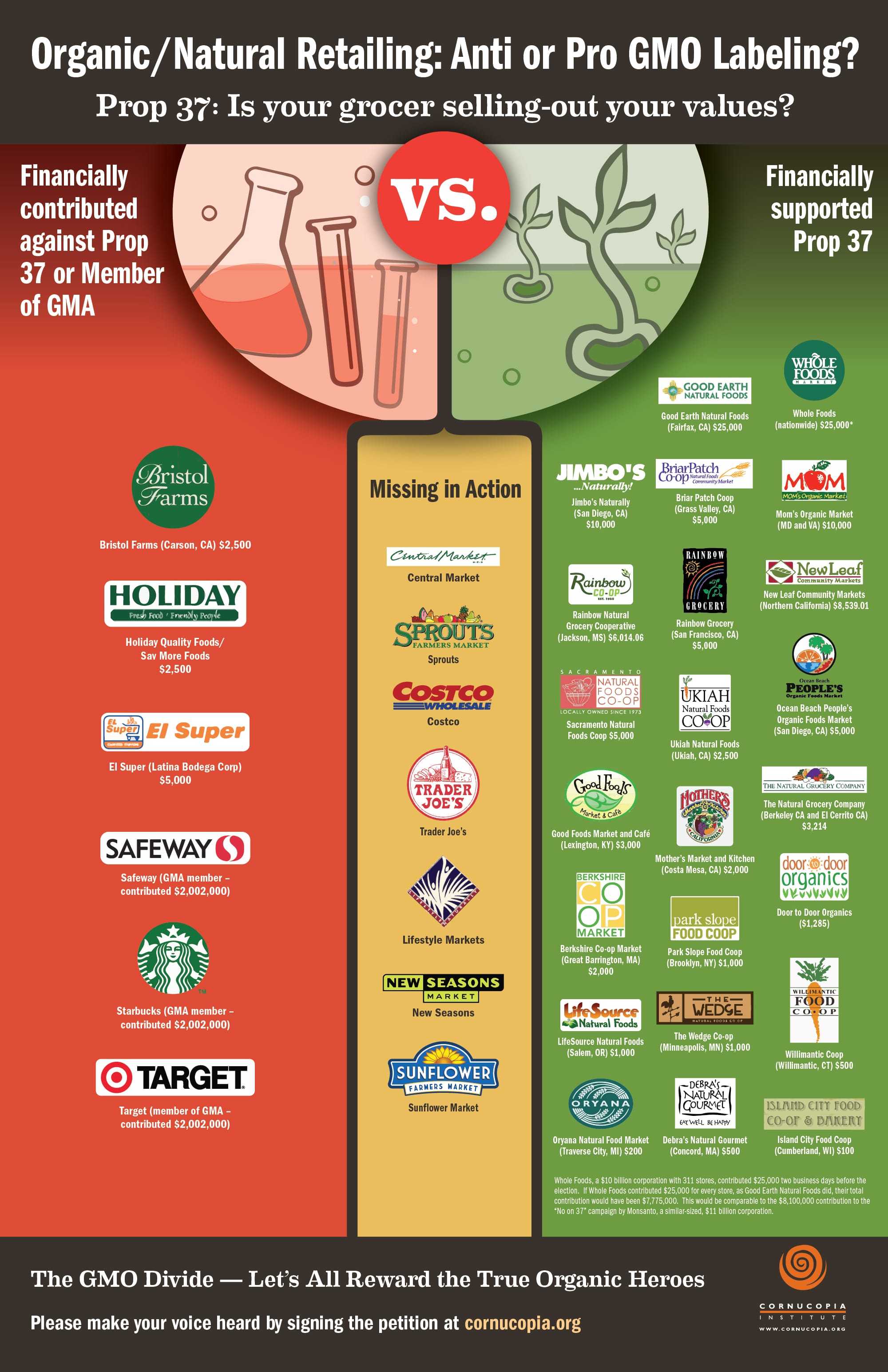
What companies opposed or supported Prop 37 (GMO labelling)
Which companies will you support?
Tuesday, 9 June 2009
Food, Inc.
"Faster, Fatter, Bigger, Cheaper."
"So much of our industrial food turns out to be rearrangements of corn."
"We can get 2 hamburgers for the (price of a vegetable)."
"We've never had food companies this powerful in our history."
"They have managed to make it against the law to criticize their products."
"When we run an item past the supermarket scanner we're voting for local, or not, organic, or not."
"Imagine what it would be if, as a National Policy, the idea would be to have such nutritionally dense foods that people actually felt better, had more energy and weren't sick as much. See, now that's a noble goal."
"People have to start demanding good wholesome food of us and we'll deliver, i promise you."
Wow.
Tuesday, 28 April 2009
Stevia/Truvia/PureVia's Safety

About this time last year I blogged about Stevia. Stevia is a plant native to South and Central America and its extracts are 300 times sweeter than sugar without the calories of sugar. This time last year, the use of Stevia in food was banned in Canada and the United States because of a lack of evidence that it was safe.
However, in December 2008, the American FDA approved rebaudioside A, the sweet extract of the stevia plant, a move that has been called "President Bush's parting gift to the soda industry". Canada and the European Union have not approved the use of Stevia in food.
What changed?
The FDA received two notices that rebaudioside A
Two corporate giants with evident interest in using the stevia extract: Cargill Inc and Whole Earth Sweetener.
These GRAS notices informed the FDA that their ingredients were safe and didn't need pre-market approval... leading to, according to a review prepared for the Center for Science in the Public Interest (CSPI), the following products being rushed to market too early:
Truvia- from Coca-Cola and Cargill- a tabletop sweetener. Moreover, Sprite Green (from Coca-Cola) is out on the market already and Coca Cola plans to use it in Coke soft drinks and plan to release new Odwalla juice drinks with the sweetener.
PureVia- from Pepsi-Cola and Whole Earth Sweetener- a tabletop sweetener. Pepsi Co has released Trop50 (Tropicana) containing the sweetener and will launch at least 3 new flavours of SoBe Lifewater.
SweetLeaf- Wisdom Natural Brands started selling SweetLeaf sweetener.
Why the concern?
Firstly, the research was industry-sponsored raising questions about the objecticity of the science - authors of the studies are scientists from Cargill and Coca-Cola (or paid by Cargill). The FDA did not follow-up.

Some independent studies have found that the stevia extracts caused mutations, chromosome damage or DNA breakage. Although in 2 studies in which one of the extracts, stevioside, was added to drinking water and fed to rats for 2 years, there was no increase in tumors. However, the most popular extract, rebaudioside A (TruVia and PureVia are 95% rebaudioside A), wasn't tested!
Furthemore, Stevia was only tested on one animal and usually, it should be 2.
Other reports found ill effects to the rats' reproductive systems: male rats fed high doses of the stevia exract for 22 months had lower sperm production and femal hamsters had fewer and smaller babies. However, a Cargill-sponsored study found no evidence of reproductive problems through 2 generations of rats fed very large doses of the stevia extract.
Evidently, more research is waranted but, according to a senior nutritionist at CSPI, there was probably a lot of pressure p
ut on the FDA to approve the new sweetener. The Stevia products are being marketed as natural because they come from a plant. To underline their natural claims, the stevia products are packaged in green. However, be aware that stevia is also being blended with other sweeteners: the makers of Splenda just introduced Sun Crystals, a mix of sugar and stevia. Stevia is also being added to some soft drinks containing aspartame.
Japanese manufacturers have been using stevia since the 70s but they don't consume nearly as much soda as North Americans.
Bottom Line:
According to the CSPI, the occasional use of a stevia product to sweeten your tea or coffee is probably safe (although taste is another matter as it has been said that there is a bitter aftertaste). However, until more reserach is done, there's no way to tell whether larger amounts will increase the risk of cancer (If Coke and Pepsi add stevia to their diet drinks, millions of people will be exposed to large amounts...) .
The general recommendation when it comes to sweeteners is to limit your intake to 2-3 sweetener-sweetened products a day.
For more general information on sweeteners, click here.
Sunday, 26 April 2009
Swine Flu: Q & A

The WHO has also called the outbreak of the Swine Flu virus in the States and in Mexico a "public health emergency of international concern".
So far as many as 86 deaths are suspected and 20 confirmed in Mexico, with over 1400 people ill. The United States, which has declared a public health emergency today, 20 cases of swine flu have been confirmed in 5 states, including New York (8), California (7), Kansas (2), Texas (2) and Ohio (1). Canada has now confirmed 6 cases in Nova Scotia (4) and British Columbia (2).
CTV and CBC News published great Q & A pieces and I'm including the main points below:
What is swine flu?
Just like humans get the flu, so do pigs. They get a fever, a cough, sneezing, lose their appetite.
Can humans catch swine flu from pigs?
Usually it's rare and, if it happens, it's people that deal directly with the pigs. On average, in the States, there are 4 cases documented a year.
1976 saw the last swine flu outbreak at Fort Dix, NJ among military recruits. At that time, the US vaccinated 40 million people fearing the outbreak would turn into a pandemic, but it didn't.
Can you catch swine flu from an infected person?
Yes- just like the seasonal flu is transmitted between humans.
Can you catch swine flu by eating pork?
No- the swine flu virus isn't transmitted through food.
Should we be worried about this outbreak?
This new outbreak is a bit worrisome because none of the people recently infected had any contact with pigs. The Center for Disease Control is reporting that this is a new virus that's a combination of bird, swine and human influenza.
American officials are asking people not to panic though. The emergency declaration lets the government free more money for antiviral drugs and give some previously unapproved tests and drugs to children. One-quarter of the national stockpile of 50 million courses of antiflu drugs will be released.
Dr. Allison McGeer, director of infection control at Mount Sinai Hospital told CBC News that, while the cases in Mexico sound like a large number, "in truth for influenza, that's a very small number." "You need to remember that in Canada alone, which is not that much bigger than Mexico City actually in population terms, 4,000 people die of seasonal flu every year."
If you're travelling, you may be asked if you have had the flu or a fever. Those that appear ill will be asked to step aside, given a mask and given medical care.Is there a vaccine?
Only for pigs- none to protect humans. The flu shot will not protect you.
What are symptoms?
Similar to regular flu symptoms: fever, lethargy, lack of appetite, coughing. Some people have also reported runny nose, sore throat, nausea, vomiting and diarrhea.
How to they diagnose swine flu?
A respiratory specimen is collected within 4-5 days of becoming ill and sent for testing.
Is it treatable?
Yes, with antivirals. The recent US swine flu cases seem to be resistant to 2 antivirals (amantadine, rimantadine) but are susceptible to zanamivir and Tamiflu.
What can you do?
The CDC is advising you to to wash your hands frequently, to cover coughs and sneezes, avoid touching your eyes, nose and mouth (that's how germs are spread) and to stay home if you feel sick.
Visit the CDC and the WHO's sites for more up-to-date info.
Wednesday, 1 April 2009
Listeria Fears Prompt Smoked Salmon Recall in Canada

This is not an April Fool's joke... there's yet another food recall!
This time, salmon has been recalled due to possible Listeria contamination. The Canadian Food Inspection Agency and Niagara Smoked Fish Limited are warning consumers not to eat certain brands of Smoked Salmon and Grav-Lox. The products have been shipped to Ontario, Quebec, Atlantic Canada and Alberta.
So far, no illnesses have been reported. However, eating foods contaminated with Listeria can cause listeriosis, a food-borne illness that can cause high fever, nausea, headache and stiff neck.
People with weakened immune systems, the elderly, pregnant women and children, are at higher risk.
The following products, bearing the registration number 0609, are affected:
• Strubs Bagelox Norwegian Style Sliced Smoked Steelhead Salmon
• Strubs Norwegian Style Sliced Smoked Steelhead Salmon
• Strubs Scottish Style Sliced Smoked Atlantic Salmon
• Strubs Danish Style Sliced Smoked Grav-Lox Steelhead Salmon
• Niagra Smoked Fish Steelhead Salmon Cold Smoked Sliced
• Niagra Smoked Fish Steelhead Salmon
• Niagra Smoked Fish Atlantic Salmon
• Ocean Jewel Smoked Atlantic Salmon, sliced
Visit the CFIA website for more information.Pistachio recall hits Canada

The Canadian Food Inspection Agency and Frito Lay Canada are warning consumers not to consume Frito Lay Munchies brand pistachios due to possible Salmonella contamination.
The product is sold in 50g packages (UPC 0-60410-04595-4)dates between Aug 4 and Dec 15 2009.
The Munchies brand was distributed all over Canada but there have been no reported illnesses yet.
Visit the CFIA website for more info.
Visit the FDA website for an updated list of recalled products.
Tuesday, 31 March 2009
Pistachio Recall: Salmonella scare

The FDA and the California Department of Public Health are advising consumers to avoid pistachio products as they investigate Salmonella contamination in pistachio products sold by the California company Setton Pistachio of Terra Bella, Inc.
The company has issued a nationwide voluntary recall today on nuts shipped on or after Sept 1 2008, about 2 million pounds of pistachios- a small fraction of the 55 million pounds of pistachios the company processed last year.
California is the second-largest producer of pistachios in the world.
The FDA states that the pistachios were used as ingredients in many products and, as a result, many products may be recalled as the investigation continues.Salmonella can cause serious and sometimes fatal infections in young children, frail or elderly people, and people with weakened immune systems. So far, according to the FDA, several illnesses have been reported by consumers that may be associated with the pistachios but it's not yet known whether any of the Salmonella strains found in the pistachio products are linked to an outbreak.
Setton has recalled their bulk roasted shelled pistachios and roasted unshelled pistachios sold to wholesale customers, as well as its Setton Farms brand roasted salted shelled pistachios (sold in 9-ounce bags with a "Best Before" date between Jan. 6, 2010 and Jan. 19, 2010) distributed in seven Southeastern states. Grocery chain Kroger Co recalled its Private Selection shelled pistachios on Friday due to potential salmonella contamination and Kraft Foods recalled its Back To Nature Trail Mix after it was found to be contaminated with Salmonella.
The FDA site will soon provide a list of recalled products... stay tuned.
Tuesday, 20 January 2009
Peanut butter salmonella outbreak: what you should avoid

The newest Salmonella outbreak in the States has been linked to peanuts. So far, about 475 people have been infected in 43 States . Moreover, the infections may have contributed to 6 deaths.
The source of Salmonella has been traced to a peanut processing plant, Peanut Corporation of America (PCA), in Georgia. PCA doesn't sell its peanut butter or peanut paste to consumers but supplies ingredients to food manufacturers.
King Nut peanut butter distributed in certain states was found to be responsible for many of the reported illnesses and has been recalled. Most peanut butters in jars seem safe but the US government is advising consumers to avoid eating cookies, cakes, ice cream, crackers and other foods that contain peanut butter or peanut paste. Click here for FDA's most current list of recalled products.
Kellogg's has voluntarily placed a hold on 16 products that contain PCA peanut paste or peanut butter, including Austin and Keebler brand snack foods and Amos cookies. There has been no reported illnesses linked to Kellogg's products and, according to the company, none of these products were shipped to Canada.
Although there have been no illnesses in Canada linked to the growing salmonella outbreak in the US, the Canadian Food Inspection Agency is warning the public not to consume certain products as they may contain PCA contaminated products.
These products include:
Hebert's Fully Loaded P.B. Crunch mini-bars produced Aug. 26. 2008 and Sept. 9, 2008.
Nature's Path Organic Optimum Energy Bar-Peanut Butter with an Oct. 1, 2009 expiry date.
Clif Bar Chocolate Chip Peanut Crunch with a Sept. 7, 2009 expiry date.
Clif Bar Crunchy Peanut Butter with expiry dates between Sept. 6 and Sept. 11, 2009 and Nov. 13, 2009.
Clif Bar Peanut Toffee Buzz with an expiry date of Sept. 12, 2009.
Clif Builders Peanut Butter Protein Bar with expiry dates of June 20, 2009 and Aug. 20, 2009
Clif Bar Club Pack 18 Variety Pack with expiry dates of Sept. 8, 2009 and Nov. 3, 2009.
Lärabar Peanut Butter Cookie snack bars
Lärabar Peanut Butter Cookie Bite Size
Symptoms of salmonella poisoning include high fever, severe headache, vomittting, nausea, abdominal pain and diarrhea. Those with compromised immune systems, ie. the elderly and children, are at greater risk.
Update: The FDA has just confirmed that salmonella was found in a package of peanut butter sandwich crackers made by Kellogg's (Kellogg's Austin Quality Foods Toasty Crackers with Peanut Butter).
Friday, 2 January 2009
Top Food Safety Stories of 2008

Bill Marler, American Food Safety attorney and advocate, came out with his list of the Top 9 Food Safety Stories of 2008:
9. Westland/Hallmark recall due to downer cows. The largest meat recall in US history. 143 million lbs of beef was recalled from Hallmark/Westland Meat Packing Co, after a video made by the Humane Society showed workers using abusive techniques to make ‘downer cows’-sick animals unable to stand up on their own- pass the pre-slaughter inspection.
8. Multistate Outbreak of Human Salmonella Infections caused by Contaminated Dry Dog Food. This outbreak resulted in hundreds of humans and a few dogs to become sick. After handling pet food, pet owners should wash their hands immediately, and infants should be kept away from pet feeding areas.
7. Spinach and lettuce-borne outbreaks. Resulted in the FDA approving irradiation of the leafy greens as existing sanitation techniques were not deemed sufficient. The debate continues about the safety of food products that have been irradiated but these products will be labelled to allow consumers to make their own decisions.
6. Frozen, uncooked entrees. Consumers were infected with Salmonella after consuming entrees that contained raw chicken products and were NOT supposed to be cooked in the microwave.
5. Listeria in Maple Leaf Deli Meats. This one hit close to home, killing 20 Canadians and causing hundreds, maybe thousands, to be ill.
4. There are those that insist that raw milk has numerous healthful benefits destroyed by pasteurization, and others that state that the bacteria in raw milk can cause illnesses, especially in children. Selling unpasteurized milk is illegal in Canada, Scotland and Australia. 28 US States allow the sale of raw milk. In both Canada and the US, raw milk cheeses that are aged for more than 61 days are permitted. In Asia, rural Europe and Africa, raw unpasteurized milk is typical.
3. E. Coli. In addition to the continued rise of E. coli O157:H7 contamination in meat and other products like leafy greens and raw dairy, 2008 saw a (non-O157) E. coli outbreak in Oklahoma causing over 300 people to fall ill and one death. Non-O157:H7 E-Coli’s are not listed yet and not tested for, but are still making people very, very sick.
2. Salmonella Saintpaul in jalapeno and Serano peppers (and not tomatoes as first believed) caused 1,442 people to be ill in 43 states, D.C., and Canada. Using the Center for Disease Control’s math that estimates that for every documented case of Salmonella in the US, another 38.5 go unreported , the total number sickened was probably closer to 50,000.
1. Melamine in Chinese food products. We first heard about melamine in Chinese infant formula, resulting in 294,000 sick infants, hundreds hospitalized, and at least six babies dying. We then heard that melamine was found in candy, coffee, tea, dairy, animal food and lots of other Chinese products, resulting in recalls, bans and now the US and Canada testing for melamine in our own products. According to Marler, melamine is pervasive, global, and it’s going to be in our food supply for a long time to come.
Thursday, 2 October 2008
What to avoid when eating out

Tuesday, 16 September 2008
Formula Kills Babies

I’m sure you've heard this story already but two babies are dead and 1253 more are sick (340 are still hospitalized) in China as a result of contaminated baby formula that was found to contain melamine, the same chemical that killed cats and dogs when it was found in pet food last year. Melamine is a chemical additive commonly used to make plastics and fertilizer. It’s high in nitrogen and when products are tested for protein, they actually just test for nitrogen. As such, this cheap additive has been used to make it appear like a product is high in protein. Melamine and one of its by-products block kidney function and, as a result, the poor babies have been suffering from kidney stones.
The contaminated milk powder has been traced to a major Chinese dairy, Sanlu Group Co. The group recalled its products last week although the Chinese media reported that some parents were complaining of problems since March. So far, over 10 000 tons of milk powder has been seized or recalled. Yesterday, Chinese authorities announced that they’ve arrested two men suspected to be responsible for the contamination.
Although Canada and the States don’t import formula from China, it’s possible that it has found its way here illegally. As a result, The Food and Drug Administration, Health Canada and the Canadian Food Inspection Agency have warned consumers to avoid baby formula from China- read the label!
Remember, if possible, breastfeeding is best....
Friday, 5 September 2008
Garlic-in-Oil... Potentially Dangerous

Clostridium Botulinum is a bacteria that causes botulism- a potentially fatal condition- and it’s actually quite widespread in nature. If the bacteria is exposed to oxygen, the spores can’t grow and can’t produce the toxins that will cause botulism. However, when you take garlic, that contains the bacteria, and cover it in oil, there’s no oxygen present. This is the perfect environment for the spores to grow and produce toxins. There is no change in smell, taste or appearance of the garlic to indicate the presence of toxins, making it all the more dangerous.
When you consume garlic with toxins, you can get botulism. Symptoms include dizziness, blurred or double vision, difficulty in breathing, swallowing and speaking , paralysis and even death.
To avoid getting poisoned, use your garlic-in-oil preparation right away and throw away leftovers. If you want to store it, refrigerate right away- don’t leave it at room temperature- and use within a week. After a week, throw it away. You can freeze your garlic-in oil preparation (the oil prevents the mixture from freezing completely) but it’s recommended you use it right away once you take it out, put it back in the freezer or, again, refrigerate right away and use within a week.
Commercial garlic-in-oil preparations are free from toxins when the product has been preserved. To make sure it has been preserved, check the ingredient list and look for salt or acid. Prior to adopting these preservation techniques, there were 2 botulism outbreaks reported in the late 1980s linked to these products. Remember to still follow the storage directions on the product.
Sources:
Garlic in Oil. http://www.hc-sc.gc.ca/hl-vs/iyh-vsv/food-aliment/garlic-ail-eng.php
Household Solutions 40. http://www.dabbler.ca/household-solutions/household-solutions-40-20080623/
Wednesday, 27 August 2008
Listeriosis outbreak in Canada

As of yesterday, there were 29 confirmed cases of listeriosis in
The listeria bacteria has been found to be the contributing factor in the deaths of 6 of the 15 cases and the other 9 are still being investigated.
Listeria is the bacteria responsible for listeriosis, a rare but fatal food-borne infection. The bacteria is found in soil, sewage, water and the feces of animals and humans. It can also be found in unpasteurized dairy products, raw meats and processed foods like deli meats and hot dogs. Eating foods contaminated with listeria can result in brain and blood infections as well as death.
Other companies that use Maple Leaf meat products have voluntarily recalled their products, including Fresh 2 Go sandwiches from A&P and Dominion, Shopsey’s Reuben sandwiches and Mac’s and Safeway sandwiches.
It can take up to 70 days after having consumed the contaminated product for symptoms to appear, therefore the number of cases is expected to rise. Symptoms include nausea, vomiting, diarrhea, stomach cramps, persistent fever, severe headache, stiff neck, loss of balance and convulsions. Individuals that are most vulnerable include infants, pregnant women, the elderly and those with compromised immune systems.
Maple Leaf President Michael McCain had this to say:
"Tragically, our products have been linked to illness and loss of life. To those people who are ill, and to the families who have lost loved ones, I offer my deepest and sincerest sympathies."
Sources:
2008 Canadian Listeriosis Outbreak. http://en.wikipedia.org/wiki/2008_Canadian_listeriosis_outbreak#cite_note-9
Sources of Canadian listeria outbreak confirmed. http://afp.google.com/article/ALeqM5jFh1ZPafbsYsSCSlq5v5-chCcDcw
Class action lawsuit launched over listeria outbreak. http://www.cbc.ca/canada/british-columbia/story/2008/08/26/bc-listeria-class-action-lawsuit.html?ref=rss
Listeria FAQ. http://www.cbc.ca/consumer/story/2008/08/21/f-listeria-faqs.html
Tuesday, 1 April 2008
I'll have a water, no lemon please.
Although food safety laws state that these lemon slices should be handled with gloved hands, they’re not always!
Next time you get a drink, you may want to forgo the lemon slice.
Sources:

