Monday, April 15, 2013
Will Monsanto Ties Influence Nutritionists' Stance on GMOs?
Labels:
Advocacy,
Dietitian,
Environment,
GMO,
Organics
| Reactions: |
Tuesday, April 2, 2013
Thursday, January 17, 2013
Saturday, November 17, 2012
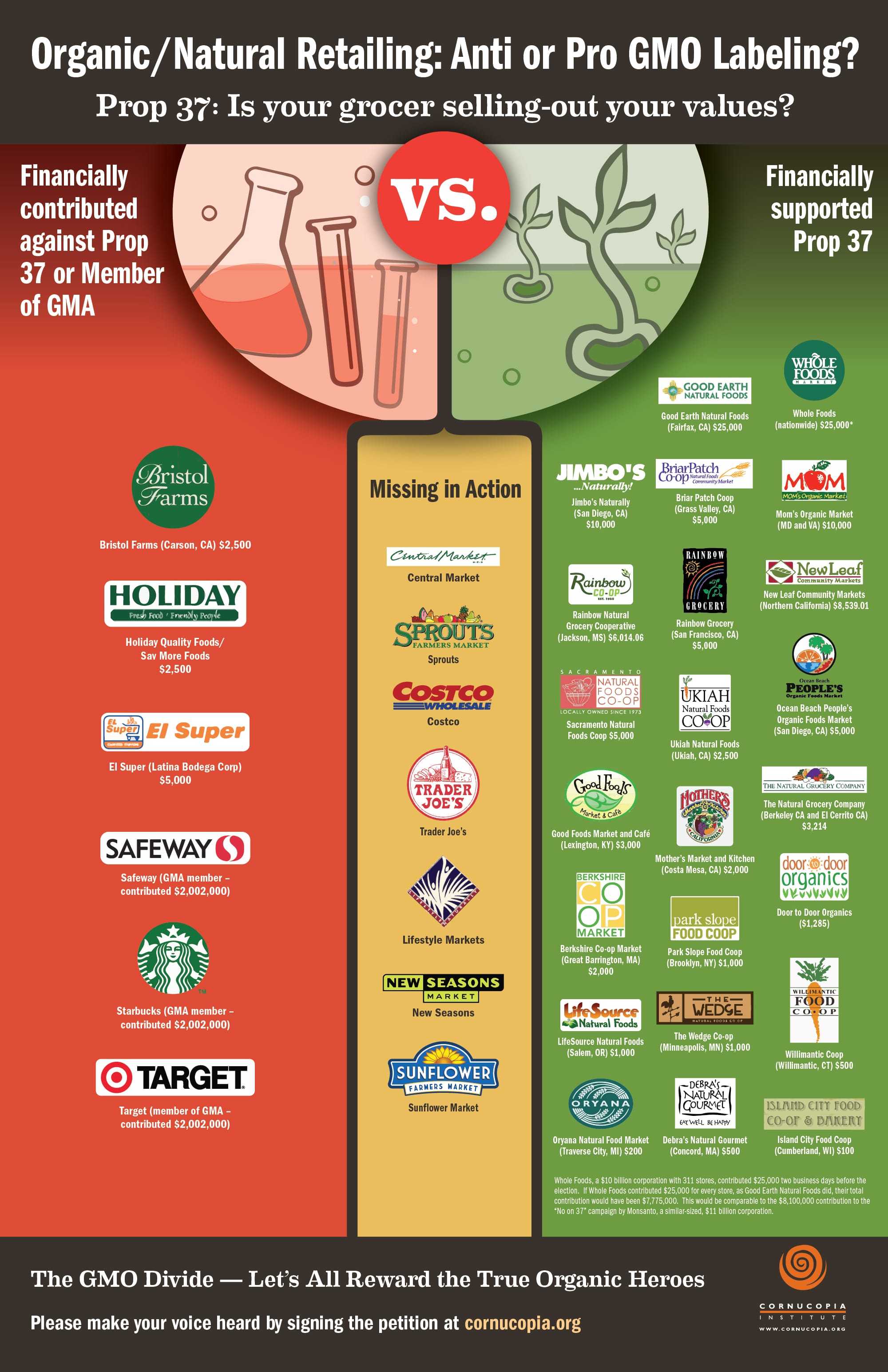
What companies opposed or supported Prop 37 (GMO labelling)
The Cornucopia Institute put together a great visual of the corporations and grocers that didn't support Proposition 37 (are against labelling GMOs), and those that did.
Which companies will you support?
Labels:
Advocacy,
Environment,
Food Safety,
GMO,
Labels,
Marketing,
Politics,
World
| Reactions: |
Monday, August 27, 2012
Rethinking the science of hydration
True or False?
- Thirst is not a reliable gauge of a body's need for water
- Urine colour is a reliable gauge of hydration (dark=dehydrated; light = well hydrated)
- It is better to rehydrate with a sports drink after exercise than with water
- We should weigh ourselves before exercise, and after. We must then drink enough fluid to make up for that weight loss to ensure complete rehydration
- Exercise-induced hyponatremia (low blood sodium) or electrolyte imbalances can be prevented (or avoided) by drinking a sports drink during and/or after exercise rather than just water
- People get sick and/or collapse due to dehydration during sporting events where fluid is provided.
I would have answered 'true' to most, if not all, of these statements. In fact, I learned that many of these statements are true in school. However, last month, BMJ published The truth about sports drinks that shed some light on the science behind dehydration and sports beverages.
The article describes clever marketing tactics on the part of the sports drink industry, including providing funding to scientists and science journals. For example, they reveal that Medicine and Science in Sport and Exercise, one of the leading sport medicine and exercise science journals, is owned by the American College of Sports Medicine that has financial ties to Gatorade and Powerade. Many of the editors on the editorial board have (and have had) ties with sports drink companies.
The article explains that this marketing, and hijacking of the science of hydration, has undermined our confidence in our own thirst mechanisms. 'They' have us believe that our bodies are unable to tell us when we're thirsty; that not drinking enough before, during or after exercise, can make us very sick ; that rehydrating only with water rather than a sports drink can cause the potentially fatal hyponatremia.
However, according to this article, there is no evidence that anybody has ever gotten ill due to dehydration during a sporting event when fluid was available. That is because our bodies tell us when it's thirsty, and we drink to satisfy our thirst.
Simple as that.
The article also explains that overhydration can lead to electrolyte imbalances and is potentially very dangerous, but can occur by drinking sports drinks just as it can by drinking too much water.
Simple as that.
The article also explains that overhydration can lead to electrolyte imbalances and is potentially very dangerous, but can occur by drinking sports drinks just as it can by drinking too much water.
I highly suggest you read the article- it's definitely interesting.
Here's a bit more from Professor Tim Noakes, Discovery health chair of exercise and sports science at Cape Town University:
Thank you, Umang!
Labels:
Athletic performance,
Exercise,
Fact or Fiction?,
Marketing,
Sodium
| Reactions: |
Saturday, July 7, 2012
The ethics of what we eat
"In the United States somewhere between 20 and 40 million birds and mammals are killed for research each year. That may seem like a lot- and it far exceed the number of animals killed for their fur, let alone the relatively tiny number used in circuses-but even the figure of 40 million represents less that two days’ toll in America’s slaughterhouses, which kill around 10 billion each year."Peter Singer- The Ethics of What we Eat
Subscribe to:
Posts (Atom)