Showing posts with label Labels. Show all posts

Saturday, 17 November 2012

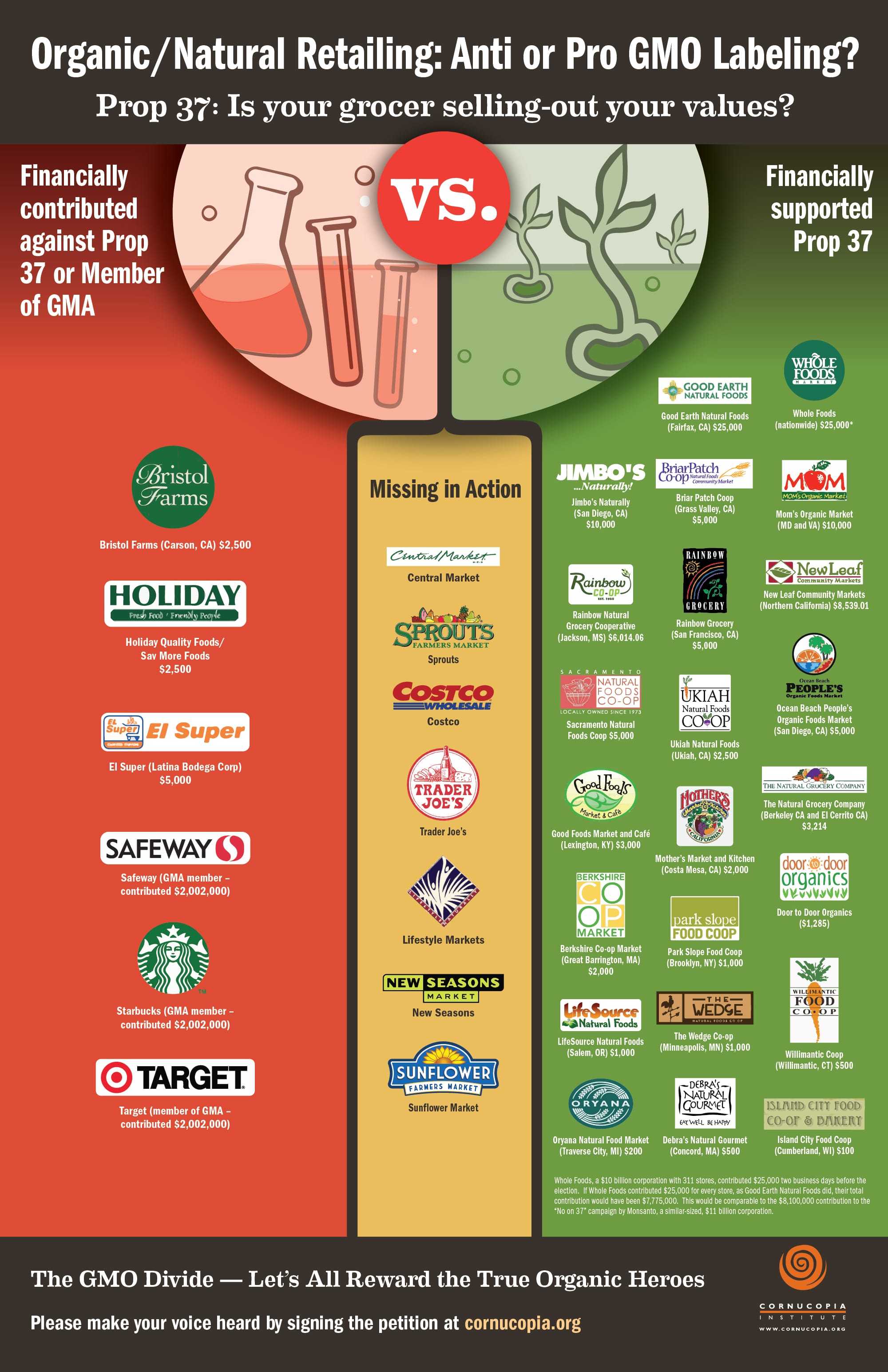
What companies opposed or supported Prop 37 (GMO labelling)

The Cornucopia Institute put together a great visual of the corporations and grocers that didn't support Proposition 37 (are against labelling GMOs), and those that did.
Which companies will you support?



Friday, 4 June 2010

GMOs Part 1: An Overview


Since its introduction, the use of biotechnology in food production and agriculture has generated much controversy. While touted as the environmentally-friendly second Green Revolution by its proponents, critics point to safety, health, and environmental risks, and ethical issues associated with this new technology.
Consumers have consistently voiced unease with genetic engineering of their food, but have unwittingly been consuming genetically modified organisms (GMOs) for two decades; Canada currently does not require GMOs to be labelled but, rather, has implemented a voluntary labelling policy.

Here’s a bit of an overview.

Biotechnology, also known as genetic engineering or genetic modification is the science of transferring genes (DNA) from one organism to another to pass on desired traits.

While surveys have indicated that individuals are largely in favour of its use in the fields of medicine and industry, its use in food production and agriculture have generated polarized viewpoints, and controversy .

Foods containing the new genes are referred to as transgenic, bioengineered, genetically engineered, genetically modified (GM), genetically modified organisms (GMO) and, due to the fear they invoke, the pejorative ‘Frankenfoods’ .

The commercial use of GM crops started in the mid 1990s. Since then, the technology has spread rapidly. Between 1996 and 2009, the worldwide land area occupied by GM crops - mainly soybean, cotton, corn, and canola - increased 80-fold, from 1.7 million to 134 million hectares, with an average yearly increase of 9 million hectares.

In 2008, GM crops were being grown by over 13 million farmers in 25 countries. The countries with the biggest share of the GM crop area are the United States (50%), Argentina (17%), Brazil (13%), India (6%), and Canada (6%).

It is estimated that at least 70% of food products on North American supermarket shelves contain GM ingredients.

Benefits of Genetic Engineering of Food

In theory, food biotechnology’s potential is manifold, touted by industry leaders as “the most important scientific tool to affect the food economy in the history of mankind,” and “the single most promising approach to feeding a growing population while reducing damage to the environment”.

The world population is projected to increase to 8.9 billion by mid-century, with global demand for rice, wheat, and maize expected to increase by 40% as early as 2020. Given the backdrop of dwindling natural resources and environmental degradation, GM crops offer the possibility of increasing yields sustainably, even in poor conditions (e.g., drought, poor soil quality), while also reducing the need for damaging and costly chemical fertilizers. In turn, this technology could offer the promise of food security in developing countries.

Nutritionally and medicinally- enhanced crops can also help improve the health status of populations suffering from malnutrition with poor access to food and medicine.

Risks of Genetic Engineering of Food

Despite the benefits of GM crops, consumer opinion surveys have consistently indicated that the public has a very negative attitude toward GM foods, expressing a concern for their safety. Industry boycotts, ecoterrorism, legal bans, and trade disputes by non-governmental organizations (NGO), governmental agencies, and concerned citizens reveal public misgiving about the risks associated with food biotechnology.

Critics, including environmentalists, scientists, farmers, consumer and health advocacy groups, public interest groups, trade protectionists, grain importers, politicians, religious rights groups, ethicists, and consumers, object to the production and marketing of GM foods primarily on the basis of food and health safety, the environment, and the ethics surrounding biotechnology.

I'll cover these in my next post!

Sunday, 25 April 2010

Sodium and Label Reading


This is our last page for a class assignment, which included writing about sodium for a website, taking original pictures and making videos for the same site (see previous posts for the rest!).

Two Soups:
Which one is the better choice?


Soup may seem like a healthy food, but most packaged soups are loaded with sodium.

Consider these two soups: a canned Tomato and Roasted Red Pepper, and a boxed Carrot and Coriander. Both look yummy, smell great, and taste delicious. But one has 6 times more sodium than the other!

How can you figure out which one has less sodium?
Read the Nutrition Facts label!

Watch this short video to learn what to look for on a label.

This information will give you the power to be able choose products that are lower in sodium and better for your health.

Making sense of the health claims on product packages can also help you make better food choices:

“Salt-Free” : Less than 5 mg of sodium per serving
“Low in Sodium” : 140 mg of sodium or less per serving
“Reduced in Sodium” : At least 25% less sodium than the regular product

Remember to also consider how much of the product you eat.
If you eat more than the serving size indicated on the Nutrition Facts label, you’re also eating more sodium!

Use the Nutrition Facts label along with health claims to know how much sodium is in the foods you choose.

Friday, 16 April 2010

Tips for Lowering your Sodium Intake

Hi!

This is still part of the fictitious website on 'sodium & health' a classmate and I developed (see previous posts). We had to write the content, take the pictures, and make a video... :)


Tips for Lowering Your Sodium Intake


Even though lots of foods are high in sodium, it doesn’t mean your sodium intake has to be high!

Here are some tips to help you lower your sodium intake.


At the grocery store:


  • Fill your cart with fresh and unprocessed foods, like fruits, vegetables, lean meats, whole grains, and lower-fat milk and alternatives. These foods naturally contain less sodium.

  • Read nutrition labels. The amount of sodium is listed as a “Daily Value” percentage that tells you how much sodium a product contains. Your best choice is a product with less than 5% sodium per serving size.

  • Choose foods that have the claims “Salt-Free”, “Reduced in Sodium”, or “Low in Sodium”.

  • Buy unsalted versions of foods like nuts, pretzels, crackers and popcorn.


At home:


  • Remove the salt shaker from your table. Instead, flavour your food with herbs and spices.

  • Don’t add salt when you cook or bake, or use less than the recipe suggests.

  • Rinse canned foods like tuna, chickpeas and beans under running water for one minute to reduce the sodium content.


At restaurants:


  • Ask to see the nutrition information and choose foods lowest in sodium. Many chain restaurants have nutrition information on their websites.

  • Request your meal to be prepared with no added salt.

  • Be careful of large portion sizes. Split a menu item with your dining partner, or take half home in a doggy bag.

  • Ask for sauces and dressings “on the side” so you can control how much you put on your food.

Wednesday, 14 April 2010

Sodium Lowering Tips- Part 2

And here's Part 2 of our 'Ask the Dietitians' segment for our fictitious website- this one's on label reading.
Enjoy! :)


Saturday, 23 January 2010

Sodium Hype- Is it justified?

As predicted, sodium has become a major public health issue. In fact, the New York City Health Department just announced their initiative for restaurants and food manufacturers to voluntary reduce sodium in their food by 25% in the next 5 years.

But is the hype justified?

A recap of what we know

The research is clear. Salt increases blood pressure.

BUT

Only about 10-25% of North Americans are salt-sensitive (Another source states that its closer to 50%), meaning that salt will only increase the blood pressure of 10-25% of the population.

The research is also clear: High blood pressure is an important risk factor for heart attacks and strokes.

But wait. Does that mean that salt causes heart attacks and strokes?

That’s the message that’s being thrown out there:

In Ottawa, the Canadian Stroke Network and Blood Pressure Canada teamed up to put ads on buses with the message: Sodium kills 30 Canadians a day.


The Center for Science in the Public Interest (CSPI), a prominent nutrition advocacy group, have been very vocal in associating sodium intake with heart attacks and strokes, stating that a reduction in sodium can save 150,000 lives a year.

Just this week, a study was published in the New England Journal of Medicine stating that reducing salt intake by 1200 mg a day (that’s quite a bit) could prevent up to 66,000 strokes, 120,000 new cases of heart disease, and 92,000 deaths a year.

Sounds good but the thing is, all of these numbers are actually just predictions based on the role of sodium on blood pressure.

Why didn’t they look at the direct role of sodium on heart attacks, stroke or death? Because that data isn't really available.

Review of the research on sodium and heart disease or death

Some fellow students and I decided to do a thorough review of the scientific literature to see if sound research had looked at the role of sodium on death, heart disease or strokes.

What we found was pretty surprising: there are very few studies looking at this direct association; only 4 in the last 10 years, in fact!

And what these 4 studies found wasn’t as clear cut as has been reported:

One study found that the higher the sodium intake, the higher the incidence of heart disease, however, the study had many limitations.

Another study also found that the higher the sodium intake, the higher the incidence of heart disease... but only in overweight people.

Interestingly, two (1,2) studies found that the higher the sodium intake, the lower the incidence of heart disease and death! (so, the lower the sodium intake, the higher the incidence of heart disease and death!)

Clearly, more research needs to be done before directly associating sodium with heart disease.

Update: Turns out that, according to the CSPI, Michael H. Alderman, an author of the aforementioned articles (1,2), is a consultant for the Salt Institute. Click here to read a great piece on the controversy over sodium-and-health papers.

What else do we know?

We know that we’re eating too much salt.

If you’re healthy, you need only 1200-1500mg sodium/day.

The upper tolerable level (the maximum you should eat) is 2300mg/day.

The average North American consumes a whopping 3000-4000mg/day.

80% of this sodium is not coming from the salt-shaker, but is in processed foods.

What does this all mean?

We are, as a population, eating too much salt.

Will a population-wide sodium reduction initiative result in lowering blood pressure? Yes, in some people.

Will a population-wide sodium reduction initiative result in less heart attacks, strokes and death? We really can’t say.

Obviously, it won't harm our health...

But would spending the energy and resources to, instead, focus on initiatives to reduce obesity rates or to make healthy foods more affordable than fast/junk food have a greater, more important, impact on our health?

What do you think?

Sodium-lowering tips

Click Here for some ways you can take matters in your own hands and reduce the sodium in your diet.


Friday, 18 December 2009

How to choose a good cereal

A better cereal choice will have

At least 4 g Total Fibre per 30 g serving.

Less than 1-3 g fat per serving - some granola-type cereals* can have up to 5 g per serving!

Less than 10g sugar per serving.

Moreover,

The first ingredient should NOT be sugar.

The first ingredient should be a "whole grain"- the word "whole" should be present.

*A better granola-type cereal will have fruit and nuts listed on the ingredient list before sugar and oil.


Let's look at a few examples:


SPECIAL K


Ingredients

Rice, wheat gluten, sugar/glucose-fructose,defatted wheat germ, salt, malt (corn flour, malted barley), vitamins (thiamine hydrochloride, niacinamide, pyridoxine hydrochloride, folic acid, d-calcium pantothenate), iron. BHT added to package material to maintain product freshness.


Ok... Special K's Ingredient list: sugar is not the first ingredient which is good, but the first ingredient is not a whole grain, not so good.


A look at the label, and although there is no fat, there is also no fibre... no good.


All in all, not the best choice- not horrible, since there are only has 2g sugar per serving, but definitely not the best.


SHREDDED WHEAT
(original)


Ingredients: Whole grain wheat, BHT is added to packaging material to preserve product freshness.


Shredded Wheat:
Whole grain is the first (and only!) ingredient on the ingredient list- great!!


The label shows that, per serving, there is only 1g fat, 0g sugar and a great 6g total fibre!!

Excellent choice.


CASCADIAN FARM- Organic Oats & Honey Granola


Ingredients (all organic): Whole grain oats, sugar, crisp rice (rice, sugar, sea salt, malt), sunflower oil, whole grain oat flour, molasses, maltodextrin, honey, sea salt, vanilla extract.


So... First ingredient is a whole grain, which is good. However, a look at the label and there are 6g fat and 14 grams sugar per sugar- too much- and only 3 g fibre- not enough.


Not a good choice!


Tuesday, 22 September 2009

The Sodium Crisis: A Major Health Concern

A few years ago, there was a huge effort to enlighten the public on the health effects of trans fats.

The result: Mandatory labeling, the removal of trans fats from many products, and entire cities banning trans fats from restaurants.


Looks like sodium's next!

The CSPI has called sodium the “deadliest ingredient in the food supply” and the “forgotten killer”.


Why is Salt Bad?

High sodium intake has been linked with high blood pressure- 1 in 6 people worldwide have high blood pressure, as do 65 million Americans. 45 million more are considered “pre-hypertensive” (between normal and high blood pressure).

Don’t have high blood pressure? Chances are you will. 90% of Americans will. And, even if you don’t have high blood pressure, cutting back on sodium can reduce your chances of getting cardiovascular diseases by 25% and your risk of dying from it by 20%. Same goes for kids!


Eating less salt is also one of the most important ways in preventing heart disease. High sodium intake has also been linked to obesity, stomach cancer, kidney stones, kidney disease, osteoporosis and an increase in asthma symptom severity.


How Much is Too Much?

The WHO recommends we eat less than 2000mg sodium/day whereas US and Canadian guidelines, based on Institute of Medicine recommendations, recommend less than 2300 mg/day, less than 1500mg/day if you have high blood pressure.


In fact, we only need about 1200-1500mg/d. As a reference, 2.5 little pickles contain 1550 mg/day.

We’re eating about double the limit, 3500-4000mg sodium/day... and that’s too much!

Where’s All This Salt?

Believe it or not, the majority of salt isn’t coming from the salt shaker. About 80% of our sodium is coming from processed foods!

Between 1994-2004, sodium in food has increased by 6%.

Packaged foods and restaurant meals are huge sources of salt in the diet. For example, a slice of pizza has about 1770mg sodium. A Denny’s Meat Lover’s breakfast (2 eggs, bacon, 2 sausages, toast and hash browns) has 3460mg sodium!

Hamburgers, pizza, hot dogs and subs are the main source of sodium in the Canadian diet.

Click here to find out what the saltiest restaurant meals in America are!

What’s Happening?

Although the food industry is slowly starting to develop lower sodium in some products- watch the commercial below for Knorr Sidekicks that have reduced sodium by 25% in 22 of their products- it’s not enough.


It’s estimated that 8.5 million worldwide deaths could be avoided over 10 years by adopting public strategies to reduce sodium intake.

The Center for Science in the Public Interest (CSPI) is asking for sodium to be recognized as a food additive rather than GRAS (Genereally Recognized As Safe) in the States, so it could be regulated. They’re also suing the restaurant chain Denny’s for not disclosing the large amount of salt in their food which, according to them, is putting unknowing consumers at a huge health risk. They also want the restaurant chain to post warnings on their menus about the high sodium levels.

Canada’s Sodium Working Group was started in 2007 and is made up science/health professionals (including 2 dietitians!), food industry and NGO representatives as well as government officials. The group plans to come up with a plan to reduce Canadian’s sodium intake in 4 years, a bit too slow for some.

New York City, always a leader in health initiatives (first to ban trans fats in restaurants and implement mandatory menu calorie labelling) has started its own initiative and plan to cut sodium in restaurant foods by 25% in the next 5 years.

Strategies That Work!

Finland, and more recently the UK, should serve as models for Canadians and Americans. Both countries have partnered with the food industry to reduce sodium in products and educate the public through mass media campaigns.

Click here for another great British ad:


Finland started this in the 70s and they’ve seen a drop in sodium intake from 5600mg/d to 3200mg/d! They’ve also seen a huge 70% reduction in stroke and heart attack deaths!

Both countries have also adopted an easy labeling system: green label for low salt, amber for medium salt and red for high salt. The result in the UK: a reduction of 400mg sodium in just 4 years!


More to come on this topic for sure!

Monday, 10 August 2009

Insects dye our food?!


Well... this is a shocker:

Turns out that it's legal, and common, for food manufacturers to use
insects as food dye, and they don't have to let us know!!

More specifically,
carminic acid is extracted from the cochineal beetle's body and eggs and used to make carmine dye, a red dye commonly used as food colouring as well as in cosmetics, fabrics, oil paints and watercolours.

Although many foods, including yogourt, ice cream, cheese, butter, fruit-flavoured and alcoholic drinks, meats, pie fillings, jams, baked goods, sauces and candies, use carmine and cochineal extracts as dye, they only have to indicate "artificial colour" or "artificial colour added" to their ingredient lists. Only man-made dyes have to be listed (ie. FD&C No. 40)). As such, we have no idea if we're eating insect extracts or not.

In 2006, the consumer advocacy group the Center for Science in the Public Interest called the FDA to
ban insect-based dyes and provided 32 adverse reation reports it had received. According to the CSPI, "Why tolerate food coloring that sends a couple hundred people to emergency rooms each year...?"

Symptoms reported after eating carmine-containing foods like Yoplait and Danone yogurt, Ocean Spay and Fruitopia juice and Good & Plenty candy included itching, swelling of the eyes and tongue, difficulty breathing, hives and headaches. Moreover, hidden beetle extracts are problematic for vegetarians and vegans, those with specific allergies and people who keep kosher.

In January 2009, the FDA finally ammended the colour additive regulation; foods containing cochineal extract or carmine must declare the presence of the colour additive with either "cochineal extract" or "carmine" in the ingredient list by January 5 2011.

At least it's a start but, according to the CSPI, why not require the ingredient to be listed as "insect-based colouring" rather than using words most people won't understand?
Why the sneakiness?


Thanks Heather for letting me know about this!

Thursday, 14 May 2009

Calcium-fortified Doritos and Cheerios is a drug... What's going on?


In Canada, we're awaiting Health Canada's decision to allow the food industry to fortify packaged and processed foods with vitamins and minerals. The decision was supposed to be made end of March but because of division within Health Canada on the merits of fortification, it's been delayed.

Health experts are understandably worried that the proposal will pass and allow junk food manufacturers to add nutrients and market their products as healthy, exacerbating unhealthy eating habits and cause confusion about nutritional benefits of certain foods.
Packaged and processed foods are generally high in calories, sugar, fat, salt, negating any benefit derived from adding some vitamins or minerals to them.


Health Canada stated that its tests on focus groups demonstrated that people are not likely to choose fortified junk food over healthy food... but health experts are skeptical.


The industry group Food and Consumer Products of Canada, representing the majority of packaged foods o
n the supermarket shelves, argues that fortificaion would allow consumers to more easily meet daily nutritional requriements. That's great but we're not a nation that is nutritonally deficient... given our over-abundance of food. In fact, another concerns is that adding all these vitamins and minerals could lead to an overconsumption of nutients. In order to avoid this, Health Canada claims that the propsed policy will limit the amount of nutrients that can be added to food and won't be left to the the discretion of food manufacturers.

Canada's food industry also argues that the out-of-date and strict fortification policies in Canada make it difficult for them to keep up with other countries and develop innovative food products. Moreover, given the fact that the US allows more products to be fortified, harmonization would cut production costs. Maybe, but doesn't make it right.

The Ame
ricans are also more liberal in their labeling laws, something that's finally getting a bit more scrutiny. The FDA has taken action against General Mills for its misleading claims that Cheerios can reduce "bad" cholesterol levels by 4% in 6 weeks and ward off heart disease and cancers of the colon and stomach. (These claims don't appear on Canadian boxes because we're more strict with our labeling laws).

In its letter to General Mills, the FDA states that if the cereal does as indicated, it's acting like a cholesterol-lowering drug and should therefore be treated like a drug- and can't legally be marketed with the claim without an approved new drug application.

Hopefully Health Canada will make the right decsion and not allow fortification of packaged and processed foods... fingers crossed!

Tuesday, 12 May 2009

Does sugar make us fat?


Sugars are simple carbohydrates composed of a single sugar (ie. glucose, fructose) or 2 sugars together (table sugar, sucrose, is made of glucose linked to fructose).
In comparison, starch is a complex carbohydrate- made of lots of glucose molecules linked together in very long chains.
The long chains can't be absorbed by the intestine but have to be broken down to single units of glucose to be useable. Simple carbohydrates, though, are readily useable. But do they make us fat?


We know that a calorie is a calorie. Excess calories from sugar will lead to weight gain, just like extra calories from protein or fat. However, when you eat too much glucose at a time, the body can't handle it. What happens is that your pancreas makes too much insulin. Insulin is supposed to take the glucose and put it in your body tissues so it can be used. When there's too much insulin though, it grabs all your available glucose, including the little bit that's supposed to stay in your blood. The result is that your blood sugar drops and you feel hungry.
You then eat more and those extra calories will lead to weight gain.
Moreover, your muscles cells start to resist taking in the excess glucose resulting in that excess getting stored as fat.

So yes. Eating too much simple sugars does put you at risk for weight gain.

Fibre slows down the absorption of glucose which is why a high fibre diet- a diet rich in vegetables, fruit and whole grains- prevents heath problems.


The Glycemic Index ranks foods according to how quickly they break down to glucose. Click
here to read more about Glycemic Index from a previous blog entry.
In general, highly processed starchy foods- crackers, pretzels, cookies- and sugary foods- sodas, candies, desserts, sugary cereals- have no fiber and will cause havoc for your metabolism, providing a huge influx of glucose.


How much sugar is too much sugar?

Per day, it's recommended that less than 10% of your total calories come from added sugars (this doesn't include sugar found naturally in fruits and plain milk). In a 2000 calorie diet, that means you should be aiming for less than 50 grams (about 10 teaspoons) of added sugar a day. The average American eats double that a day.

Sweet tips to limiting your sugar intake


Avoid or cut back on non-diet soft drinks. A 12 oz can of Coke has practically your daily limit of added sugars, 40 grams!!

Watch out for fruit 'drinks', 'beverages', and 'cocktails'- they contain very little real fruit juice and a lot of sugar.


Limit candy, cookies, cakes, pies, doughnuts, granola bars, pastries and other sweet baked goods- eat fruit instead. Desserts in restaurants, with their huge portion sizes, have a large amount of added sugar. A medium chocolate milkshake at McDonald's has a whopping 111g sugar!


Remember that 'fat-free' does not mean 'sugar-free' or 'calorie-free' .

Look for breakfast cereals with less than 10 grams (ideally less than 8 grams) of sugar per serving- read the label!

I found this cool site, sugarstacks.com , that shows us how much sugar there are in some foods. Pretty eye-opening!
They use sugar cubes- 1 cube is equivalent to 1tsp or 4grams.


Saturday, 18 April 2009

How Many Calories Do We Need?


There are two schools of thought when it comes to counting calories for weight loss:

1. Don't waste your time and focus on the quality of your diet.


2. It's an essential tool for weight loss.
As one
doctor specializing in weight loss I worked for put it: "before you buy something it's a good idea to know how much is in your bank account, how much you make a month and how much it costs. As far as weight goes, it's currency is Calories and therefore it's a good idea to know how many Calories you burn in a daytime, how many you've had and how many you want".

I go back and forth on this one. However, if you agree with the latter school of thought, the following will help you:


How to determine how many calories you consume?


1. Measure your serving size using measuring cups and spoons.

2. Read the label: look at the serving size and the calories for that serving size.

3. Calculate and write down the calories in your serving.


For example: If you ate 4 cookies and the label on the cookie bag indicates that there are 100 calories for 2 cookies, you ate (2 x 100 calories) 200 calories.


You can use the online program
Calorie King to determine calories in foods without labels (ie. produce).

How to determine how many calories you need?


Of course, caloric needs vary widely, depending on factors like gender, age, height, weight and physical activity.
Dietitians use various equations to calculate caloric needs and in 2005, the Journal of the American Dietetics Association published a review of the various equations used (Harris-Benedict, Mifflin-St Jeor, Owen, WHO/FAO/UNU). The Mifflin -St Jeor equation was found to be the best (for both obese and non-obese individuals), predicting Resting Metabolic Rate within 10% of the measured value.

The Mifflin-St Jeor equation below estimates your Basal Metabolic Rate (BMR: the minimum number of calories your body needs to maintain your weight at complete rest). You must multiply the value obtained by an Activity Factor.


Remember that this equation is an estimate only of your caloric needs since many factors affect metabolic rate. It is meant only for healthy, non-pregnant adults.

BMR =

Male: 10×weight + 6.25×height - 5×age + 5

Female: 10×weight + 6.25×height - 5×age - 161


Weight: in kilograms. If you know your weight in pounds, divide by 2.2 to obtain to get your weight in kilograms.

Height: in centimeters; if you know your height in inches, multiply by 2.54 to get your height in centimeters
.

Click
here for an online BMR calculator that uses the Miffline-St Jeor equation. You must multiply your BMR with the appropriate Activity Factor to determine your daily caloric needs for weight maintenance:

Activity factor:

If you are sedentary (little or no exercise) : 1.2

If you are lightly active (light exercise/sports 1-3 days/week): 1.375

If you are moderately active (moderate exercise/sports 3-5 days/week): 1.55

If you are very active (hard exercise/sports 6-7 days a week): 1.725

If you are extra active (very hard exercise/sports and physical job or intense training, ie. twice a day): 1.9

Is weight loss a goal for you?

For a reasonable and healthy weight loss of 1lbs a week, subtract your total daily caloric needs measured above by 500 calories:


Daily caloric recommendation for weight loss: (BMR x Activity Factor) - 500

Remember that a woman should never consume less than 1200 calories a day and a man should never consume less than 1500 calories a day.