Showing posts with label Politics. Show all posts

Saturday, 17 November 2012

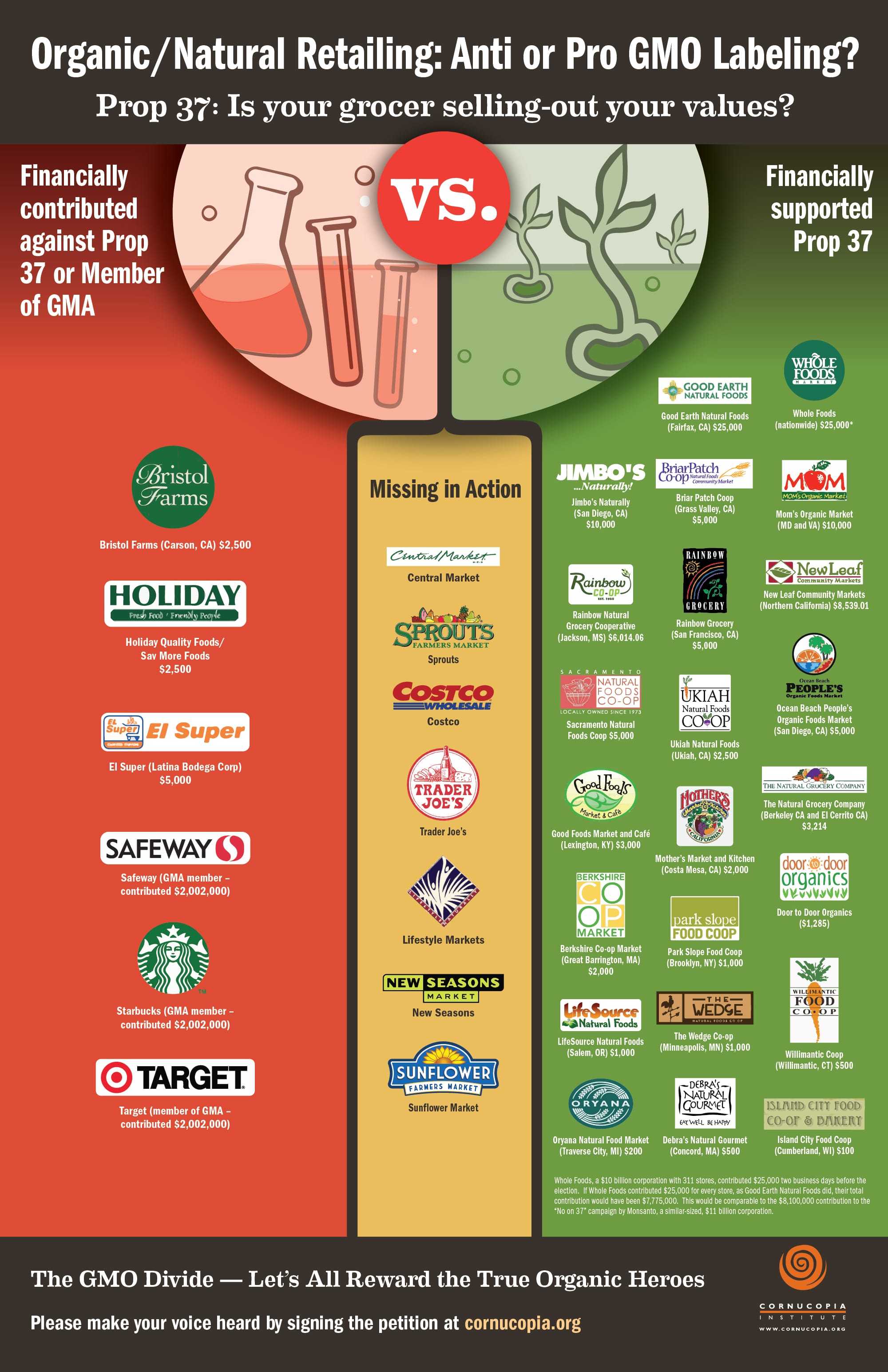
What companies opposed or supported Prop 37 (GMO labelling)

The Cornucopia Institute put together a great visual of the corporations and grocers that didn't support Proposition 37 (are against labelling GMOs), and those that did.
Which companies will you support?



Thursday, 19 August 2010

Seeds of Hope: We are the leaders we've been looking for

In the clip below, Grace Lee Boggs, author and activist, talks about change.

While she states that our planet is currently facing a serious time of uncertainty, she sees hope, and a movement emerging where, instead of people complaining about things, they're doing something about it.

She gives the example of Will Allen, former basketball player and current urban farmer, community organizer, writer and activist. Allen puchased a 2-acre piece of land to grow food for a community. According to Boggs, growing our own food provides a way for young people to relate to the earth, their elders, and time, in a different way.

In answer to the question often posed, "How do I make a difference?", Boggs says that it should be something local and something real- however small. Even starting a dialogue is doing something.

When asked if there are leaders we can look to, Boggs states that we have to rethink the concept of leaders; leader implies power.
Instead, we need to embrace the idea that we are the leaders we've been looking for.

Inspiring!


Thursday, 18 February 2010

Where We Are Now


"We have a health system that doesn't care about food and a food system that doesn't care about health"


-- Wendell Berry, American philosopher on food and farming


Source

Tuesday, 9 June 2009

Food, Inc.

"If you knew, you might not want to eat it."
"Faster, Fatter, Bigger, Cheaper."
"So much of our industrial food turns out to be rearrangements of corn."
"We can get 2 hamburgers for the (price of a vegetable)."
"We've never had food companies this powerful in our history."
"They have managed to make it against the law to criticize their products."
"When we run an item past the supermarket scanner we're voting for local, or not, organic, or not."
"Imagine what it would be if, as a National Policy, the idea would be to have such nutritionally dense foods that people actually felt better, had more energy and weren't sick as much. See, now that's a noble goal."
"People have to start demanding good wholesome food of us and we'll deliver, i promise you."


Wow.

Friday, 10 April 2009

Soda tax


For some reason, this topic is very controversial. Let's look at both sides.

New York City's health commissioner Dr. Thomas R. Frieden and Kelly D. Brownell, director of the Rudd Center for Food Policy and Obesity at Yale University argue for taxing sugared beverages in this week's edition of the New England Journal of Medicine.

40 states have small taxes on sugared beverages but in the past year, Maine and New York, and other states, have proposed larger taxes.

These are the authors' main points for this tax:


- Research indicates that sugared beverages (soda sweetened with sugar or corn syrup, carbonated and uncarbonated drinks, energy drinks) are associated with increased weight and risk of obesity, poor nutrition, increased risk of diabetes. As a result, sugar-sweetened beverages may be the single largest driver of the obesity epidemic.

- Sugared beverages account for 10 to 15% of the calories consumed by children and teenagers. For each extra can or glass of sugared drink consumed a day, a child has a 60% increased risk of becoming obese.

- For every 10% increase in price, it is estimated that consumption would decrease by 7.8%. An industry trade publication reported that as prices of soft drinks increased by 6.8%, sales dropped by 7.8%, and as Coca-Cola prices increased by 12%, sales dropped by 14.6%.

- If 1/4 of the calories consumed from sugared beverages are replaced by other foods, the decrease in consumption would lead to an estimated reduction of 8000 calories per person per year which would result in a weight loss of just over 2lbs a year for the average person, reducing the risk of obesity, diabetes and heart disease substantially.


- The cost of unhealthy eating is an estimated $79 billion annually for overweight and obesity alone.


- A penny per ounce excise tax on soft drinks would raise an estimated $1.2 billion in New York State alone.
- Americans consume 250 to 300 calories more daily than they did decades ago, nearly half of which are a direct result of sugared beverages.

Opponents of the tax contend that:

- Taxing food is not like taxing alcohol or tobacco since people need to eat to survive.

- It is unfair to single out one food to tax and taxing one food will not solve the complicated obesity epidemic. Dr. David Jenkins of the U of Toronto (who holds the Canada Research chair in metabolism and nutrition) suggests that a better idea would be to use rewards, such as making gym memberships and exercise programs tax-deductible.

- Susan
Neely, president and CEO of the American Beverage Association, contends that taxing sweetened drinks would have no effect on reducing obesity but would only financially harm families because of higher grocery costs.

- The "Nanny State" argument: It shouldn't be government's role to determine or influence people's diets.

What do you think?

Thursday, 9 April 2009

Eat your views!


"The way I see it, you've got 3 opportunities every day to act on your values and have an immediate effect on something you're concerned about."

-Christine Lemon, Food & Wine.

Tuesday, 4 November 2008

Americans celebrate Election Day with doughnuts, coffee and ice cream


Election day in the States. Vote!

If you’re in the States, you can get a free star-shaped doughnut from Krispy Kreme (~110 calories), a free scoop of ice cream from Ben & Jerry’s (~230 calories) between 5-8pm and a free cup of coffee from Starbucks.

These companies were going to offer this free food to voters only, but Election laws prohibit that. As a result, they're proclaiming the giveaway part of a national party to celebrate the election.

Enjoy the free treats!


Thursday, 11 September 2008

Slow Food


The Slow Food movement started in Italy in 1989 as a protest against the opening of a McDonald’s in Rome. The movement’s founder, Carlo Petrini, sought to fight industrial ‘fast food’ eating and remind consumers not only of the joys of eating, but of where their food comes from. Slow Food, now an international association with over 85 000 members in 132 countries, proposes responsibility on the part of the consumer- something they’ve termed ‘ecogastronomy’.

The movement is committed to safeguarding local and traditional foods and methods of preparation, to educating about the risks of fast food, factory farming, agribusiness and monoculture, to promoting ‘taste education’, to lobbying against use of pesticides, to teaching students and prisoners gardening skills, to developing political programs to preserve family farms and to encouraging ethical buying practices in the marketplace.

Just recently, Slow Food USA hosted the inaugural Slow Food Nation in San Francisco. Founded by Alice Water, one of the most influential American chefs and one of the earliest champions of the organic and local food movements, it was the largest celebration of American Food in history, with about 60 000 people in attendance.

Wednesday, 18 June 2008

The Industry's Food Guide


A lot can be said about this picture...
but I'm just going to post it for now.
Source: bmimedical.blogspot.com

Wednesday, 11 June 2008

Beef riots in South Korea

Large rallies with tens of thousands of demonstrators, the mobilization of 21 000 riot officers, candlelight vigils and the offer of resignation from the Prime Minister and the President’s entire cabinet, all because of beef?!
That’s what’s happening right now in South Korea.

Korea was once the third largest importer of US beef but in 2003 it imposed a ban on American beef as a result of mad cow disease being detected in American Cattle.

However, in April, President Lee cut a deal with Washington to lift the ban on importing US beef, prompting an uproar from the population that fears for their health. Sources do point to the fact that these demonstrations are also about President’s Lee’s leadership and policies. According to Tami Overby, president of the American Chamber of Commerce in Seoul, “beef is a lightning rod for everyone who has a beef with President Lee".

So far, shipment of US beef into Korea has been suspended until a deal can be signed preventing cattle of over 30 months old from entering the country, in hopes of assuaging the population’s food safety fears. Both Seoul and Washington continue to insist U.S. beef is safe, but protesters say they can't trust the President, and there seems to be no end in sight to the demonstrations.


Sources:
http://www.time.com/time/world/article/0,8599,1813235,00.html
http://www.cbc.ca/world/story/2008/06/10/korea-beef.html
http://www.ohmynews.com/NWS_Web/View/at_pg.aspx?CNTN_CD=A0000915078&PAGE_CD=N0000&BLCK_NO=3&CMPT_CD=M0001&NEW_GB=