Showing posts with label Holidays. Show all posts

Tuesday, 19 January 2010

Weight Around the World


Did you know that this week is Healthy Weight Week?
Yup!
January 17-23rd is a week to celebrate healthy weight- whatever your healthy weight is for you- and healthy, diet-free, eating.
Today is an extra special day too because it's also 'Get Rid of Fad Diets' day!

Our society is definitely too obsessed with achieving a specific weight- which is why we need reminders like these 'holidays' (there's also 'No Diet Day' May 6th!)-
but looks like we're not alone. Reader's Digest polled 16, 000 people in 16 countries about weight and diet.

This is what they found:

Who's Trying to Lose Weight?

Finland

83% of Finns said they've tried to lose weight. The US and Canada aren't far behind....


The Country Where Wives Most Want Their Husbands to Lose Weight

USA

51% (more than half!) of married American women wish their husbands were thinner.


The Country Where Husbands Most Want Their Wives to Lose Weight

India

48% of Indian men said they're dissatisfied with the shape of their spouse (46% of Indian women say the same of their husbands though!).

In the States, 47 % of married American men wanted their wives to lose weight.


What Country Feels the Most Pressure to be Thin?

Brazil


What Country Pops the Most Diet Pills?

China
While Brazilians' pill popping doubled between 2001-2005, China takes this one with 37% of Chinese admitting to taking weight loss pills.
19% of American said they have taken weight loss pills.

Click Here for the full article.

Thursday, 31 December 2009

Happy 2010!


Don't diet this year... and you won't have to beat yourself up... Eat healthy, stay active, and have a wonderful New Year!

"May all your troubles last as long as your New Year's resolutions!"
-Joey Adams

Wednesday, 3 June 2009

Every day should be National Running Day!


It was National Running Day in the States today!

According to
runningday.org, it's a day to "come together as a nation to take strides towards leading healthier, fitter lives".

As a runner, I think every day should be Running Day!

I posted previously that running has been found to slow the aging clock and it was found NOT to be associated with osteoarthritis or knee replacement surgeries, as commonly thought. Moreover, a recent study at the University of Missouri comparing bone densities of runners and cyclists found that regular cyclists were 7 times more likely to suffer from osteopenia of the spine than runners! People who engage in activities like biking, swimming, rowing, elliptical training need to incorporate bone-strengthening activities, like resistance training or running, to their exercise regimens.

Interestingly, the
same researchers also found that running may build stronger bones than even resistance training since lifting dumbells, for example, won't do much for the strength of your hip bone. Therefore, high-impact, dynamic, multi-directional activities, like running (as well as sports like soccer, basketball, volleyball and even structured jump-training such as in high-impact step aerobics) result in greater gains in bone strength.

So, if you didn't run today, why not lace up your running shoes tomorrow and go for a run... or incorporate some running bouts into your daily walk?


See you out there...!

Wednesday, 6 May 2009

Today is International No Diet Day!


The International No Diet Day, started by British feminist Mary Evans Young in 1992, is a celebration of body acceptance and body shape diversity and a day dedicated to raising awareness of the dangers of dieting.


The Body Image Coalition recommends:

  • Celebrate your natural size, eat well and be physically active every day
  • Pay others a compliment based on something other than weight-related qualities
  • Don't compare your body to others
  • Avoid fad diets and eat healthily
  • Help young people understand that the image of beauty portrayed in the media are not normal.
Sounds good to me!

Disappointment with diets shouldn't come as a surprise. I've blogged about the lemonade diet recently. There's the cabbage soup diet, the grapefruit diet, the Subway diet, the Scarsdale diet (promising 1 lbs weight loss a day!), the cookie diet. The list goes on. The fact is, you'll lose weight if you follow these diets... at least for a little while. However, the more restrictive the diet, the more hungry you'll be and the more you'll crave once-favourite foods you've given up. You'll inevitably "cheat", leading to feelings of failure and hopelessness and, in turn, you'll most likely give up on all weight loss strategies, including the good ones like exercise.

A healthy sustainable diet with lots of choices, few (if any) restrictions and no 'special foods' that's not only good for your waistline but for your heart, bones, brain, colon and psyche is what will help you meet your goals and keep you happy and healthy for a lifetime.

Wednesday, 22 April 2009

Earth Day Freebies


Go to any Starbucks in Canada (some US stores may be participating) or Target in the States with a reusable cup or tumbler and a free fill of brewed coffee. (on any day, Starbucks will offer a $0.10 discount when you bring a reusable cup).

Bring 3 empty plastic bottles to a
Disney store and get a free gift.

If you shop at Walgreens today, you'll get a free re-usable shopping tote.


Reynolds is offering a free 100% recycled aluminum foil with a mail-in rebate. Click
Here for information.

Live in New York? Lightbulb maker Sylvania is driving a branded Mister Softeee truck around New York City and giving out
free soft serve ice cream and distributing product coupons for Sylvania CFLs. The truck stops first at 10 a.m. at the Lowe’s in Brooklyn, then heads into Manhattan to stop at Bryant Park around 12 p.m. and then Times Square at 1 p.m.


Sources: abcactionnews

Tuesday, 21 April 2009

A Greener Diet: How the foods we eat impact our environment


The Center for Science in the Public Interest (CSPI) has a great Eating Green Calculator you should try... it allows you to enter the servings of animal products you eat in a week to determine the impact your diet has on the environment: pounds of fertilizer and pesticides used yearly to grow animal feed, acres of grain and grass needed for animal feed and pounds of manure created by the animals you eat. The program then allows you to make changes to your diet and calculate how those changes can reduce your environmental burden.

The website also allows you to score your diet: you enter the servings of certain foods you eat in a week and the program calculates a Health Score, Environmental Score and Animal Welfare Score. Kinda cool.

The CSPI encourages everyone to take the
Pledge to eat less meat and dairy:

To protect my health and the environment, I will eat a more plant-based diet—more fruits, vegetables, whole grains, beans, and nuts and fewer fatty meat and dairy products. When I do eat animal products, I will emphasize ones that are lower in fat and raised in humane ways that minimize harm to the environment.

What are the CSPI's 6 arguments for a greener diet?

1. Less chronic disease and overall health: The fat and cholesterol in meat, dairy, poultry and egg products cause about 63, 000 deaths from heart disease a year. Apart from heart disease and hypertension, consumption of meat and other animal products have been linked to an increased risk of cancer and diabetes.

2. Less foodborne illnesses: More than 1000 Americans die annually from foodborne illnesses linked to meat, poultry, dairy and egg products.

3. Better soil: Currently in the States, 100 million acres of land is used up to grow crops to feed livestock. In fact, 66% of US grain ends up as livestock feed. This practice depletes the topsoil of nutrients and erodes the soil (a typical acre of US cropland loses an average of 5 tons of soil a year!) , as does overgrazing of grasses by livestock. 22 billion pounds of fertilizer and immense amounts of pesticides are used to grow the animal feed is used, disrupting the ecosystem, poisoning wildlife and polluting waterways.

4. More and cleaner water: 80% of all freshwater in the States is used for agriculture, Half of available irrigation water (14 trillion gallons annually) is used to grow food for US livestock (1 trillion alone is used directly by livestock). Fertilizer, pesticides, manure, antibiotics and eroded soil pollute water.

5. Cleaner air: Methane gas produced by cattle and livestock in 2000 had the same impact on global warming as 33 million cars! Livestock are the largest source of ammonia releases on Earth, contributing to smog, acid rain as well as respiratory and other health problems.

6. Less animal suffering: 140 million cattle, pigs and sheep, 9 billion chicken and turkeys and millions of fish, shellfish and other sea creatures are slaughtered a year in the United States. Food animals are not protected by federal animal welfare laws making common procedures such as chopping animals' beaks, horns, tails, or testes legal.

Click Here to download their entire "6 Arguments for a Greener Diet" book.

Happy Earth Day!

Monday, 13 April 2009

Eggs: From Hen Eggs to Easter Eggs

Hen Eggs


Hens are busy in the US: 240 million laying hens produce 66 billion eggs a year. There are white eggs and brown eggs (difference is only in the hen's breed), free-range eggs, omega 3- rich eggs (laid by hens fed a diet rich in
flax seeds... note that it's the "wrong" type of omega 3 for heart health). One hen egg has about 75 calories but more cholesterol than any other single food, all of it in the yolk: 210mg cholesterol. The American Heart Association and The Heart and Stroke Foundation of Canada recommend limiting cholesterol to less than 300mg/day, less than 200mg if you’ve had a heart attack or stroke, if you have diabetes and if you have high LDL (bad) cholesterol.

Ostrich Eggs


Of all the world’s bird species, the ostrich produces the largest egg: one egg weighs about 3lbs and yields the equivalent of two-dozen chicken eggs! An egg can also be refrigerated for up to a full year thanks to its substantial shell (roughly 1/8-inch thick). Supposedly, ostrich eggs taste very similar to hen eggs but contain a day's worth of calories (2000!) and take a bit longer to cook: start-to-finish time for hard-boiling an ostrich egg is roughly an hour and a half. One ostrich egg white can make 100 meringues or 32 souffles.

Turkey Eggs


Turkey eggs are not very popular, largely due to the expense of producing them: an average turkey weighs 5 times more than a chicken, taking up more space in the coop, and whereas the average chicken lays 300 eggs a year, turkeys lay only 100.

Seagull Eggs


Who knew?! You can eat the eggs of what are often referred to as 'urban pests'... although you shouldn't eat too many as they contain high levels of PCBs (environmental pollutants). Supposedly, their strong nutty, slightly fishy, flavour make them quite the delicacy: in Norway they're served hard-boiled in the shell alongside a glass of beer, in the UK- where around 40 000 eggs are sold yearly- they are often served hard-boiled with celery salt. Just recently, the UK's Telegraph reported that the highly sought after delicacy of black-headed seagull eggs may disappear from the nation's top restaurants. There are 25 people licensed to collect seagull eggs but sources say that only about 1/3 of them, all over retirement age, are still actively involved and there is reluctance in issuing new licenses. Conservationists are also concerned over the impact the practice may be having on the black-headed seagull population which is in long-term decline.

Emu Eggs


The emu is the national bird of Australia but emu meat and eggs are starting to make an appearance in the States. Artists known as “eggers” carve intricate designs in the emu shells or use them in jewelry making. Slightly smaller than an ostrich egg, an emu egg provides the equivalent of 10 chicken eggs. The eggs can be refrigerated for up to two months.

Duck Eggs


Duck eggs are richer and fattier than chicken eggs. In parts of Asia, fertilized duck eggs with small developing ducks inside (known as balut) are served boiled and are thought to be an aphrodisiac.

Quail Eggs


Gourmets report that quail eggs are among the most delicious in the world. The eggs are small and fine, about 1/5 the weight of a chicken’s egg and contain about 1/5 of the calories of a chicken egg (15 calories) and 1/5 of the protein (1.2g). In Asia, raw quail yolks are used in sushi; Colombians dress hot dogs with hard-boiled quail eggs along with pineapple jam and potato chips; In some Latin American countries, quail eggs are considered an aphrodisiac; Brazilians eat more than half a million quail eggs a day.

Fish eggs


Some people insist that only properly processed eggs from Caspian or Black Sea sturgeon (sieved to remove the egg sacs, leaving only the eggs) merit being called caviar (it is the most expensive) whereas others will include salted and sieved eggs from salmon, trout, flying fish, and paddlefish, and even land animals—French snail farmers introduced escargot caviar in 2007. Dwindling fishing yields, overfishing and pollution have resulted in certain restrictions, ie. the US Fish and Wildlife Service banned the import of Black and Caspian Sea Beluga caviar. In general, the lighter the colour of the fish eggs, the more expensive it is. The most expensive caviar comes from the Beluga Sturgeon of the Caspian sea. The only known outlet of this "Almas" caviar is the Caviar House & Prunier in London’s Picadilly that sells a kilo in a 24-karat gold tin for £16,000. It also sells a £800 tin for those on a smaller budget.


Easter (Painted) Eggs


The egg was a symbol of the rebirth of the earth in Pagan celebrations of Spring and was adopted by early Christians as a symbol of rebirth. Painting eggs dates back some 2500 years to the ancient Persians who did so to celebrate Nawrooz, their New Year that falls on the Spring Equinox. These eggs are not meant to be eaten!

Chocolate Eggs


Chocolate eggs appeared in the early 1800s in France and Germany after manufacturers developed a way to make solid eating chocolate. Today, chocolate eggs account for roughly 8% of all annual chocolate sales, and people buy more chocolate candy for Easter than for any other holiday except Valentine’s Day- 90% of adult
s buy chocolate on Easter in North America.

Source: Gourmet

Wednesday, 1 April 2009

The Swiss Spaghetti Harvest: Earliest Example of Farm to Table

In 1957, the BBC reported on Switzerland’s spaghetti crop. According to the report, spaghetti cultivation wasn’t carried out in Switzerland to the same scale as it was in Italy... it was more of a family affair.

It turns out that the last 2 weeks of March are an anxious time for the spaghetti farmer as there’s always the chance for a late frost, something that would impair the flavour of the pasta.

The report is also the first time that the now popular `farm to table` concept was mentioned!

Nonetheless, some things never change... there really is ``nothing like homegrown spaghetti! “

Happy April Fool`s Day!!

Tuesday, 11 November 2008

Combat Cuisine

Every year on November 11th Canadians, and the citizens of the Commonwealth countries, pause in a silent moment of remembrance for the men and women who have served, and continue to serve our country during times of war, conflict and peace. More than 1 500 000 Canadians have served our country and more than 100,000 have died. They gave their lives and their futures so that we may live in peace”.

In Flanders fields the poppies blow
Between the crosses,
row on row,
That mark our place; and in the sky
The larks, still bravely singing, fly
Scarce heard amid the guns below.

We are the dead. Short days ago
We lived, felt dawn, saw sunset glow,
Loved, and were loved, and now we lie
In Flanders fields.

Take up our quarrel with the foe:
To you from
failing hands we throw
The torch; be yours to hold it high.
If ye break faith with us who die
We shall not sleep, though poppies grow
In Flanders fields.

Lt.-Col. John McCrae


Nutrition on the battlefield

The Institute of Medicine determined that the average service member, classified as highly active men aged 18-30, burns 4200 calories a day during combat. However, it was found that they only consumed 2400 calories a day, creating a large caloric deficit. The military understands the importance of food on performance, indicating directly on their food packages:

"Restriction of food and nutrients leads to rapid weight loss, which leads to: loss of strength, decreased endurance, loss of motivation, decreased mental alertness."

Researchers and technicians have been trying to improve quality, taste and packaging of combat food since the American Revolutionary War in an effort to keep soldiers healthy and happy: from canned foods during the Civil War to lightweight salted and dried meats during World War I, back to canned C rations through the Korean War to the MCI (Meal, Combat, Individual) during the Vietnam War and to the more recent MRE (Meal, Ready-to-Eat) and First Strike Ration (FSR).

Meal, Ready-to-Eat (MRE)

In 1983, the MCI (still referred to as C-rations) was phased out by the MRE, mainly because the MRE weighs 13-18oz versus 2.7lbs for the same number of calories.

MRE meals provide 1200 calories, have a shelf life of 3 years at 27°C, and are able to withstand a parachute drop of 1200 ft.

A typical MRE contains a main course and side dish, dessert, crackers, spread of cheese, peanut butter or jelly, a powdered drink (fruit flavoured, cocoa, coffee, tea, sport drink or dairy shake), plastic utensils,a flameless ration heater (FRH) and an accessory pack (includes gum, water-resistant matches, napkin, towelette and seasonings). The food is packaged is a flexible ‘can’ to maintain sterility.
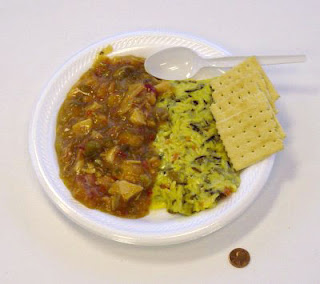
There are currently 24 different meals available, including pork rib with clam chowder, turkey breast with gravy and potatoes, manicotti with vegetables, chicken with thai sauce and yellow/wild rice pilaf and country captain chicken and buttered noodles.

In 1992, servicemembers were able to enjoy a hot meal in the field with the introduction of the flameless ration heater (FRH). Magnesium dust is mixed with salt and a little iron dust in a thin, flexible pad about the size of a playing card. To activate the heater, a soldier adds a little water.Within seconds, the flameless heater reaches the boiling point. The soldier then simply inserts the heater and the MRE pouch back in the box that the pouch came in and, within ten minutes, dinner is served.

Despite all the innovations, MREs are still popularly referred to as: Mr. E (mystery), Meals Rejected by Everyone, Meals, Rarely Edible, Meals Rejected by the Enemy, Morsels, Regurgitated, Eviscerated, Meal, Ready to Excrete, and Materials Resembling Edibles.

Their low fibre content have also lead to the nicknames: Meals Refusing to Exit, Meals Refusing to Excrete, and Massive Rectal Expulsions.

In 2001, the First Strike Ration (FSR) was created by the US Army Soldier Systems Center. FSR foods don’t need to be reconstituted with water but take the form of pocket sandwiches that can be eaten by hand, on the go. FSR has a 2 year shelf life, includes nutrition bars, electrolyte drinks and caffeinated gum and provides triple the calories of the MRE, 3600- 3900 calories, for the same weight.