The Government of Canada is proposing 4 front of package nutrition symbols − which do you think will be most helpful?
Consultation closes April 26, 2018.

Monday, 9 April 2018



Thursday, 12 December 2013
The apple core is a myth
One third, or 1.3 billion tons of food produced for human consumption is wasted every year.
In Canada alone, $27 billion worth of edible food is thrown out annually.
Turns out that by throwing away your apple core, you've been an unwilling contributor to this troubling state of affairs.
Why?
Because, according to James Hamblin, the apple core doesn't exist!
That's right. It's a myth.
It's time we reevaluate... everything.
Monday, 15 April 2013
Will Monsanto Ties Influence Nutritionists' Stance on GMOs?
Will Monsanto Ties Influence Nutritionists' Stance on GMOs?
Tuesday, 2 April 2013
Thursday, 17 January 2013
Saturday, 17 November 2012
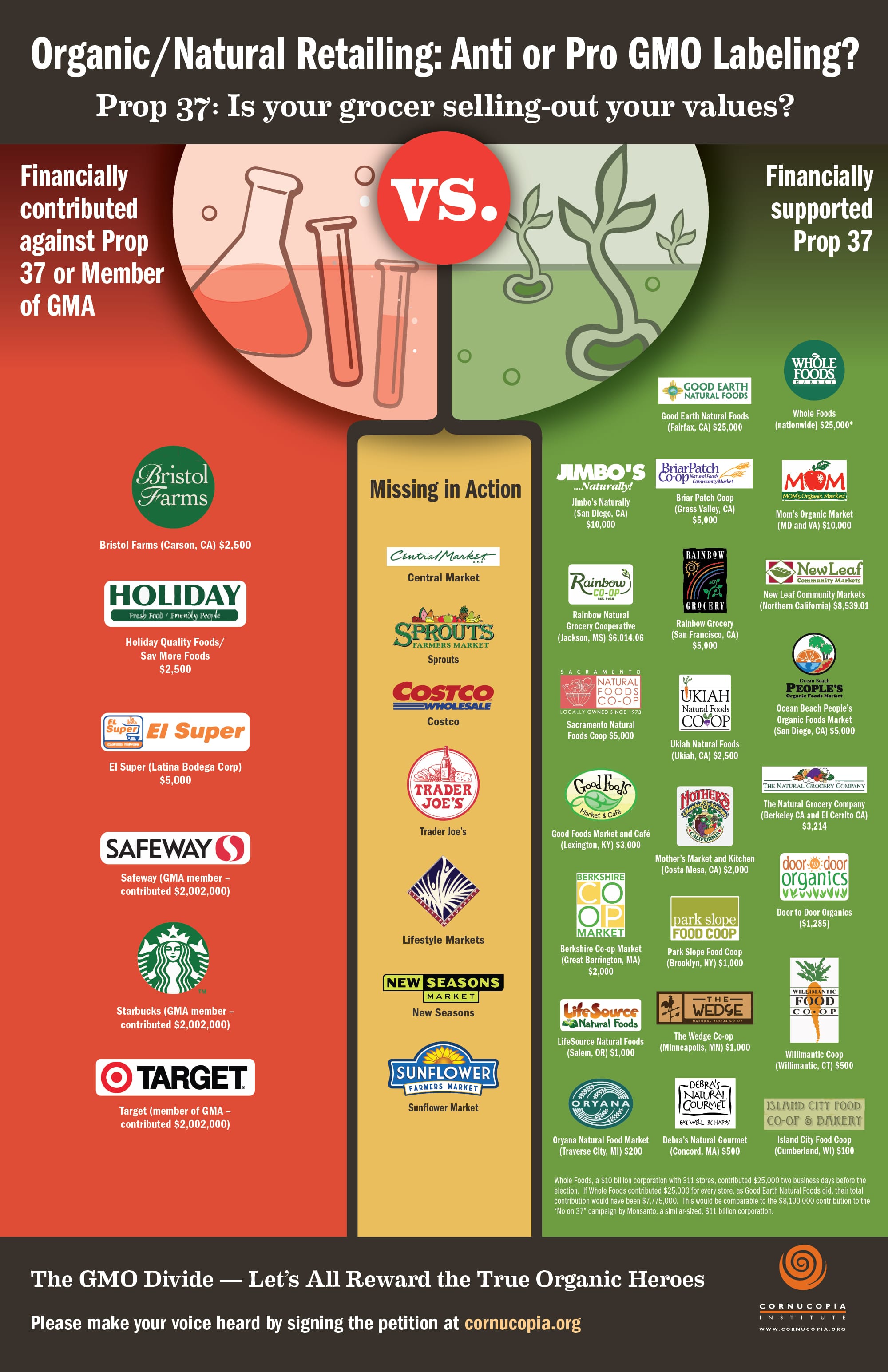
What companies opposed or supported Prop 37 (GMO labelling)
The Cornucopia Institute put together a great visual of the corporations and grocers that didn't support Proposition 37 (are against labelling GMOs), and those that did.
Which companies will you support?


Which companies will you support?

Monday, 27 August 2012
Rethinking the science of hydration
True or False?
- Thirst is not a reliable gauge of a body's need for water
- Urine colour is a reliable gauge of hydration (dark=dehydrated; light = well hydrated)
- It is better to rehydrate with a sports drink after exercise than with water
- We should weigh ourselves before exercise, and after. We must then drink enough fluid to make up for that weight loss to ensure complete rehydration
- Exercise-induced hyponatremia (low blood sodium) or electrolyte imbalances can be prevented (or avoided) by drinking a sports drink during and/or after exercise rather than just water
- People get sick and/or collapse due to dehydration during sporting events where fluid is provided.
I would have answered 'true' to most, if not all, of these statements. In fact, I learned that many of these statements are true in school. However, last month, BMJ published The truth about sports drinks that shed some light on the science behind dehydration and sports beverages.
The article describes clever marketing tactics on the part of the sports drink industry, including providing funding to scientists and science journals. For example, they reveal that Medicine and Science in Sport and Exercise, one of the leading sport medicine and exercise science journals, is owned by the American College of Sports Medicine that has financial ties to Gatorade and Powerade. Many of the editors on the editorial board have (and have had) ties with sports drink companies.
The article explains that this marketing, and hijacking of the science of hydration, has undermined our confidence in our own thirst mechanisms. 'They' have us believe that our bodies are unable to tell us when we're thirsty; that not drinking enough before, during or after exercise, can make us very sick ; that rehydrating only with water rather than a sports drink can cause the potentially fatal hyponatremia.
However, according to this article, there is no evidence that anybody has ever gotten ill due to dehydration during a sporting event when fluid was available. That is because our bodies tell us when it's thirsty, and we drink to satisfy our thirst.
Simple as that.
The article also explains that overhydration can lead to electrolyte imbalances and is potentially very dangerous, but can occur by drinking sports drinks just as it can by drinking too much water.
Simple as that.
The article also explains that overhydration can lead to electrolyte imbalances and is potentially very dangerous, but can occur by drinking sports drinks just as it can by drinking too much water.
I highly suggest you read the article- it's definitely interesting.
Here's a bit more from Professor Tim Noakes, Discovery health chair of exercise and sports science at Cape Town University:
Thank you, Umang!
Saturday, 7 July 2012
The ethics of what we eat
 "In the United States somewhere between 20 and 40 million birds and mammals are killed for research each year. That may seem like a lot- and it far exceed the number of animals killed for their fur, let alone the relatively tiny number used in circuses-but even the figure of 40 million represents less than two days’ toll in America’s slaughterhouses, which kill around 10 billion each year."
Peter Singer- The Ethics of What we Eat
Thursday, 5 July 2012

Monday, 16 April 2012
Ottawa gets its own Food Action Plan. Have your say

Toronto's Health-Focused Food Strategy
Two years ago ‘Cultivating Food Connections: Toward a Healthy and Sustainable Food System for Toronto’ was published. The report was the next stage of the Toronto Food Strategy, developed in large part by the Toronto Food Policy Council, and proposed a new vision for the food system; a health-focused one that would become part of the city’s policies and programs.
This health-focused food system is one that:
•Fosters food-friendly neighbourhoods
•Promotes social justice
•Supports nutrition and disease prevention
•Builds strong communities
•Creates local, diverse and green economic development
•Protects and sustains the environment
•Empowers people with food skills and information
•Nourishes links between city and countryside
Here are the differences between the existing food system and the one proposed in the report:

Rather than compete with city priorities and resources, the new proposed food system uses
food activities to help meet Toronto’s ongoing goals.
The report proposed six priority areas for action:
1. Support Food Friendly Neighbourhoods
2. Make Food a Centerpiece of Toronto’s New Green Economy
3. Eliminate Hunger in Toronto
4. Connect City and Countryside through Food
5. Empower Residents with Food Skills and Information
6. Urge Federal and Provincial Governments to Establish
Health-Focused Food Policies
Ottawa’s Food Action Plan: Get involved!

Toronto is just one of the forward-thinking cities addressing food issues, joining New York, San Francisco, the United Kingdom, and now Ottawa.
Food for All is a 2-year project led by Just Food that aims to develop a community-driven food action plan that involves:
-Food insecurity and health
-Physical access to food (incl.: food retail environments, food deserts, transportation, etc.)
-Food access in schools
-Food production in urban areas
-Food production in rural areas
The Action Plan has 14 components, listed below, that you can read and comment on... but hurry! We only have until Sunday April 22nd to provide online feedback:
Toward a Breastfeeding Friendly Ottawa
Healthy School Food Environments in Ottawa
Income and the Cost of Eating
Community Programming for Food Security, Food Education & Awareness
Access to Food: Planning and Zoning
OC Transpo and Food Access
Edible Landscapes
Community Gardening and Urban Agriculture on NCC Lands
Healthy Corner Stores
Community Gardening on Private Land and City of Ottawa Land
Prevention, Identification and Remediation of Soil Contamination
Hens in Urban Areas
Bees in Urban Areas
A Food Policy Council for Ottawa
Thursday, 5 April 2012
Who's the largest toy distributor in the world?
You'll never guess.
According to Frugal Dad, McDonald's is the world's largest toy distributor, giving out more toys annually than Toys R Us!
Here are a few more interesting stats on the fast food chain.
"(The) infographic lays out some of the details of the recent San Francisco Healthy Food Ordinance, and it also explores some of the facts behind how McDonald’s has become such a popular chain with children".
Source: http://frugaldad.com
Thanks Beth!Saturday, 10 March 2012
Slacktivism and social change
For the past few months my brain has been on a bit of a vacation... that’s what it feels like anyways. I’m drawn to chick-lits over books on current affairs, romantic comedies over documentaries, and knitting over blogging. When I do blog, they’re not always my own thoughts. I post video clips that interest me, links to online petitions for causes I believe in, or re-write other people’s point of views I agree with... without necessarily looking critically into the issues or organizations.

I’m really not proud of this but, on some level, I guess I feel like I’m raising awareness or adding my voice to an issue I think is relevant.
Slacktivism, defined by Wikipedia, describes "feel-good" measures, in support of an issue or social cause, that have little or no practical effect other than to make the person doing it feel satisfaction... The underlying assumption being promoted by the term is that these low cost efforts substitute for more
substantive actions rather than supplementing them.
This Wiki page includes criticism and defenses of slacktivism. One of the critics they cite is Malcolm Gladwell. In his New Yorker article, Gladwell argues that “activism that challenges the status quo—that attacks deeply rooted problems—is not for the faint of heart.” This “high-risk activism”, he says, is often built around strong personal ties.
For example, the volunteers for the 1964 Mississippi Freedom Summer Project – three of which were killed and many others beaten or arrested - who stayed with the project despite the risks also had friends that stayed. The Greensboro Four who staged the sit-in at the “whites only” lunch counter of Woolworth’s in 1960 were all close friends. In contrast, he states that social media is based on weak ties and rarely leads to high-risk activism. He writes that these tools are great to get people involved when there’s very little for them to do (like “liking” a page or signing a petition). “Facebook activism succeeds not by motivating people to make a real sacrifice but by  motivating them to do the things that people do when they are not motivated enough to make a real sacrifice”.
 motivating them to do the things that people do when they are not motivated enough to make a real sacrifice”.
Gladwell also contends that to successfully take on a powerful, organized establishment, activist efforts need to be organized around a hierarchical organization with rules and procedures, and controlled by a single central authority. Social media is not hierarchical but rather builds networks bound by loose ties, where decisions are made through consensus. “The instruments of social media are well suited to making the existing social order more efficient. They are not a natural enemy of the status quo”.
Because there is no clear authority, Gladwell states that networks have difficulty reaching consensus and setting goals. “They can’t think strategically; they are chronically prone to conflict and error. How do you make difficult choices about tactics or strategy or philosophical direction when everyone has an equal say?”
In contrast, social activist Grace Lee Boggs advises that as we look forward to the social changes that she sees are upon us, we need to rethink the concept of leaders. She stated that leader implies power, and we must embrace the idea that we are the leaders we've been looking for.
 Was she foreshadowing the Occupy movement? This movement defines itself as “a people-powered movement” that uses “a non-binding consensus based collective decision making tool known as a ‘people's assembly’”. The movement has been lambasted by many for not having a clear agenda (although, according to Naomi Wolf, this might have been part of a coordinated smear campaign against the movement organized at a very high national level. She reported that they in fact have a clear agenda).
Wayne Roberts - Canadian food policy analyst and writer- defended the Occupy movement which, in his opinion, is based on the same principles as the city-based food movement:
In the interconnected and webbed world created by the Internet, platform-providing, rather than content-promoting, organizations have come to the fore...As social movements catch up, community-based power will gravitate toward organizations featuring platforms, portals and places, rather than specific content—which is why the people who lament the lack of content in various occupations are out of it. Platforms are about opening discussions, not closing them and about providing options not mutually exclusive options.
He goes on to point out that the majority of grassroots food organizations have been platform-based, rather than content-specific. Organizations don’t focus on specific pre-defined issues, but “serve as forums for discussion, and hosts of initiatives and experiments.”
A few days ago, the organization Invisible Children released their latest campaign video calling for the arrest of Joseph Kony – head of the Ugandan Lord’s Resistance Army and most wanted man on the list of the International Criminal Court for his atrocious war crimes- by the end of 2012. The much-watched video is a lesson on how to use social media to motivate young people to ‘action’, using a great narrative, cool music and, maybe most importantly, targeting celebrities (and policy makers). The video ends with their call to ‘action’:
1. Sign the pledge to show your support
2. Get the bracelet and the action kit (posters, stickers)
3. Sign up to donate a few dollars a month and join their army for peace
4. Above all, share their movie.
No high-risk a
 ctivism here.
While nobody is really questioning Invisible Children’s motives or that Kony should answer for his crimes, the organization has been highly criticized (click here, here or here) for a number of reasons including, but not limited to: its misuse of money (the majority of which seems to have been used for its own marketing), its support for the corrupt Ugandan army- despite the fact that Kony is currently in the Democratic Republic of Congo, its oversimplification of the situation in Uganda, its neo-colonialist ‘solution’ of calling for the ‘White Americans’ to save the Africans.
Ugandan Journalist Rosebell Kagumire wrote:
The film is void of any means like peace efforts that have gone on and it simplifies the war to Joseph Kony — a mad evil man. This war was bigger than Joseph Kony and those who will end it won’t be Americans. It’s a complex war that requires African governments  of Uganda, South Sudan, Democratic Republic of Congo and Central
 of Uganda, South Sudan, Democratic Republic of Congo and Central
African Republic to work together to pacify the region... All in all it’s a very imperialistic film trying to touch sentiments of those who can ‘save’ Africa i.e. Hollywood and the West.
I am glad for social media that we are able to watch this kind of work and we react. This kind of condescending attitude towards Africa and its problems shouldn’t be given space in the 21st century.
For her full video commentary, click here.
For her full video commentary, click here.
In an interview, Grant Oysten, 19-year old political science student and one of the first to post his criticism of KONY 2012, stated that he’s alarmed that people took up the cause so readily without looking at the issue more critically. He worries that people will feel like they know everything about the issue after having seen the video. The purpose of his post, he says, was to present arguments against the message propagated by Invisible Children, in order to start a more balanced dialogue.
He writes:
Is awareness good? Yes. But these problems are highly complex, not one-dimensional and, frankly, aren’t of the nature that can be solved by postering, film-making and changing your Facebook profile picture, as hard as that is to swallow. Giving your money and public support to Invisible Children so they can spend it on supporting ill-advised violent intervention and movie #12 isn’t helping. Do I have a better answer? No, I don’t, but that doesn’t mean that you should support KONY 2012 just because it’s something. Something isn’t always better than nothing. Sometimes it’s worse.
Is that true? Is something not always better than nothing?
Canadian journalist at the CBC, Evan Solomon, questions the KONY 2012 backlash, asking if this is a case of the perfect getting in the way of the good. He states that KONY 2012 is not policy, but a polemic (a form of dispute, wherein the main efforts of the disputing parties are aimed at establishing the superiority of their own points of view regarding an issue) and that the mainstream media should ha
 ve the courage to admit that none of us would be talking about Kony without this video. “Whats wrong with Justin Bieber telling kids to stop a killer?,” he asks.
He contends that critics are missing the bigger political implication: “can foreign policy be driven by social media and youth activism? Is it smart politics or dumbed-down do-goodism?”
***
My take home message comes from social activist Grace Lee Boggs on what it takes for change to happen:
“It takes a whole lot of things. It takes people doing things. It takes people talking about things. It takes dialogue. It takes a change in the way we think”.
Tuesday, 21 February 2012
Saturday, 18 February 2012
Occupy the Food System
 In December, Willie Nelson, President of Farm Aid, wrote an amazing piece for the Huffington Post. In it, he points out how concentrated the agricultural market is- a very small number of firms control the majority of the market, threatening competition and resulting in market abuses:
93% of soybeans and 80% of corn grown in the United States are under the control of Monsanto; four companies control up to 90% of the global trade in grain; 3 companies process more than 70% of beef in the U.S.; 4 companies dominate close to 60 % of the pork and chicken markets.
Nelson gives example of the power these large corporations have, overturning GIPSA in the US - proposed fair market contract rules under Grain Inspection, Packers and Stockyards Administration that would have made it illegal for packers and slaughter houses to unfairly discriminate against independent farmers - and using $5.6 million in lobbying costs to overturn US Department of Agriculture rules that would have changed the standards for school lunches to reduce the amounts of starch and sodium and increase the amounts of fresh fruits and vegetables.He ends:
Despite all they're up against, family farmers persevere. Each and every day they work to sustain a better alternative -- an agricultural system that guarantees farmers a fair living, strengthens our communities, protects our natural resources and delivers good food for all. Nothing is more important than the food we eat and the family farmers who grow it. Corporate control of our food system has led to the loss of millions of family farmers, destruction of our soil, pollution of our water and health epidemics of obesity and diabetes.
We simply can't afford it. Our food system belongs in the hands of many family farmers, not under the control of a handful of corporations.
"We are farmers, we grow food for the people"
 In March 2011, the Public Patent Foundation filed the landmark lawsuit, Organic Seed Growers and Trade Association (OSGATA) et al v. Monsanto on behalf of family farmers, seed businesses and farming organizations to challenge Monsanto’s patents on genetically modified (GMO) seeds and protect farmers from the biotech seed and chemical giant’s abusive patent infringement lawsuits.
At the heart of the lawsuit is the threat that farmers face due to genetic trespass as a result of Monsanto’s GMO seed and the aggressive enforcement of their alleged patent rights.
I stand with Farmers vs. Monsanto
After hearing the arguments, Judge Naomi Buckwald stated that on March 31st she will hand down her decision on whether the lawsuit will move forward to trial.
For more information and how to get involved, visit Food Democracy Now!
Willie Nelson teamed up with Chipotle to release this ad against factory farming and for sustainable agriculture. Download the song from itunes- proceeds go to the Chipotle Cultivate Foundation.
Wednesday, 25 January 2012
Saturday, 15 October 2011
Thursday, 10 February 2011
Top culinary destinations
According to Keith Bellows, Editor in Chief of National Geographic Traveler magazine,
“A meal is more than an intake of calories; it’s an exercise in cultural immersion. What people eat, when they eat, where and how they source the food, what gastronomic rituals they observe – all offer telling insights to a place and its people.”
It's that time of year to start dreaming about the next vacation destination.
Here are Bellows' top 5 culinary destinations.
What's yours?
(I'm a little partial to #5 myself...)
Wednesday, 9 February 2011
Is the American Dietetic Association Dropping its Corporate Sponsors?

Wednesday, 2 February 2011


Wednesday, 15 December 2010
The Ironman
In my opinion, there's no greater sporting event.
Swim 18 miles (29km) per week
Bike 350 miles (560km) per week
Run 60 miles (96km) per week
Calories burned weekly: 30 000
Extra meals per week an ironman eats: 42
Pounds an ironman would lose per month without these extra meals: 34
Swim 3.8 kilometers (2.4 miles) , Bike 180 kilometers (112 miles) and Run 42 kilometers (26.2 miles). All under 17 hours.
It's the Ironman.
And if you can't join them... watch them in action this Saturday (December 18th)!
What these athletes will do to just get to the start line is monumental by any standards.
Swim 18 miles (29km) per week
Bike 350 miles (560km) per week
Run 60 miles (96km) per week
Calories burned weekly: 30 000
Extra meals per week an ironman eats: 42
Pounds an ironman would lose per month without these extra meals: 34
Subscribe to:
Posts (Atom)